Tuesday, 7 April 2015

Stories

When Alice and Philip alight from the Schwebebahn in Wuppertal, they find a hotel almost opposite the station entrance on Sonnborner Strasse. The girder of the Schwebebahn, which in this section is suspended above the road, lies directly outside of the window of the hotel room. A train goes past as Philip tells Alice when she has asked for a bedtime story, "I don't know any stories". Philip Winter, played by Rüdiger Vogler, in Alice In The Cities is introduced to the audience as a writer in the first part of the film, before he meets Alice and her mother, although he has been unable to write while in America; returning to Europe with Alice appears to provide inspiration and motivation for him to write. As Bruno Winter in Kings Of The Road, he repairs cinema projectors; Philip Winter returns as a private detective several years later in Until The End Of The World and Faraway, So Close!, and finally as a sound engineer in Lisbon Story. It might be fair to assume that Rüdiger Vogler stands in for Wim Wenders (even as a different character - to match his different occupations as Winter - in the middle film of the 'road movies trilogy', The Wrong Move), not as an alter ego perhaps, but something of a specifically German everyman, born into the same 1940s generation as Wenders, who came of age in a divided Germany in the 1960s.

After announcing that he knew no stories, Philip relents and begins, ”Once there was a man" but after an interruption he corrects himself and starts again: "Once there was a little boy who got lost”. Each 'figure' in Philip’s story - like a musical figure - passes in succession, seemingly with only its linear sequence to connect it with the statement before, which has echoes of the structure of the road movie itself: "and then..." - "and then" Alice asks when there is a pause. This emphasises the clear storyness of the story, its episodic motifs tumbling past each other as Philip improvises its forward movement long enough for Alice to fall asleep. The soundtrack theme by Can re-appears and Philip closes the window to mute the sound of the Schwebebahn.

Since the hugely successful Paris, Texas, it sometimes feels that the stories are imposed on Wim Wenders films: in contrast, with the best of his films from the 1970s, the story, or the narrative, was rather more contingent on character and location, even with those films with external sources, his 'B-films': The American Friend's Jonathan Zimmermann in Hamburg, or Wilhelm Meister moving through 1970s West Germany in The Wrong Move. In later films, character and location become subservient to the narrative - Wings Of Desire being a case in point: despite its reputation, with its self-defining seriousness, it has none of the sure lightness of touch that makes Alice In The Cities such a joy. Despite a few directorial mis-steps, Lisbon Story, a later exception, touches these contingencies again. In recent years, Wenders is more happy as a documentarian: here, the material can be shaped from the outside, rather than from the inside in a fictional narrative.

On the train to St Petersburg nineteen months ago, as passengers' travel documents were checked by passport and customs controls, the man seated at our table, who had pronounced crossing the border, "very John le Carre", told us the bare outline of a fascintating story:
"The train stops at Vyborg. Russian customs (in green) and passport/visa control in black, with forage caps and all that we saw were female. The passenger sitting adjacent, next to T- proffered the information that he used to live here, in Vyborg, that it wasn't a very Russian city, having been Finnish and under Swedish control. [We later saw that he had a Norwegian passport and spoke fluent Russian to the customs officials.] He told us that he had met a woman about ten years ago, who was 113, living in a Soviet era apartment with her daughters, in their eighties. She had been married and had a family before the Russian Revolutions of 1917. She had been a prisoner of war [in the second world war] captured by the Germans, and had been in a camp in Kaliningrad. He said that it had been [a] German [city and he couldn't think of the name]. I was able to offer that it had been known as Königsberg. He said that she had told him at the end of the war she had walked home to Vyborg "on her own two legs". He had said he'd asked her if she had any photographs, documentation of this remarkable journey. She had said that photographs were the last thing on her mind."
Later, the man went to the buffet car saying something along the lines of the fact that one could always find better company there - I think we weren't convivial or gregarious enough fellow passengers for him. The short few sentences about the 113-year old woman were bound up with a century's worth of upheavals in ideology, history and nation states themselves. Vyborg, where the train was stopped, had been Viipuri when Finnish, which it had been when this woman would have been born in 1890. As part of the Grand Duchy of Finland, it was ruled by the Tsar, but with a relative amount of autonomy; it then became part of an independent Finland after the civil war following the revolutions of 1917. After the Winter War, the Soviets captured and annexed Vyborg; it then briefly returned to Finnish control with the Continuation War, and finally became part of the Soviet Union once again, and was recognised as such with the Moscow Peace Treaty.

The location where the woman had been held as a prisoner of war had a similarly complicated twentieth century history. Königsberg was the major city of East Prussia, and at the beginning of the century this was a contiguous part of Germany itself, seat of the Hohenzollerns who became the emperors of a united Germany. After the First World War, this became an enclave, cut off from Germany by the Polish corridor, which stretched across former Prussian lands to the Baltic Sea. At the end of the Second World War, the victorious Allies determined to simplify the map of Europe by forcing the mass migration of Germans into the redrawn boundaries of post-war Germany, a form of ethnic cleansing designed to forestall any future conflicts of expansion. East Prussia was ceded to the Soviet Union and its German identity erased. Königsberg became Kaliningrad, and by an irony of fate, with the fall of the Soviet Union, Kalinigrad Oblast became an enclave once again, remaining Russian, while now surrounded by the EU countries of Poland and Lithuania
"There is something extraordinary about the decision of the Allied control council, in February 1947, to abolish the state of Prussia by an act of law. Unlike most laws issued by the council, this one has a miniature history lesson in the preamble. It says Prussia, which had since times of yore been the seat of reaction and militarism, is hereby demolished. The explanation for the law is in its wording. The state is seen as the source of militarism and reaction in German history and for that reason it has to be exorcised from the European map. It is an unquiet spirit that must be dispelled."
Christopher Clark, quoted in Neil MacGregor, Germany: Memories of a Nation
Living in the United Kingdom, an island with 'natural' geographical borders, although with the contentions of Ireland and to a lesser degree Scotland, brings with it a sense of national identity that does not necessarily need to be questioned. It is hard therefore to imagine what it may be like to live in contested lands, especially in the last century or so of the nation state - essentially a recent concept, but one that it would be difficult to conceive of a world without: in certain parts of Europe boundaries and allegiances have changed numerous times in the last one hundred years. However, with closer integration within the EU, perhaps regional identities - within being 'European' - will begin to feel more important than national identities, much as a writer like Stefan Zweig may have felt before the outbreak of the First World War.

As light relief, in Jerome K. Jerome's Diary of A Pilgrimage, he recounts being stuck in a train carriage with a very talkative man, who tells a long story about a dog, which remained undefined by its shagginess or not, but this feels knowing:
“After the dog story, we thought we were going to have a little quiet.  But we were mistaken; for, with the same breath with which he finished the dog rigmarole, our talkative companion added: “But I can tell you a funnier thing than that—” We all felt we could believe that assertion.  If he had boasted that he could tell a duller, more uninteresting story, we should have doubted him; but the possibility of his being able to relate something funnier, we could readily grasp. But it was not a bit funnier, after all.  It was only longer and more involved.  It was the history of a man who grew his own celery; and then, later on, it turned out that his wife was the niece, by the mother’s side, of a man who had made an ottoman out of an old packing-case.”
Jerome K. Jerome, Diary of a Pilgrimage

Monday, 6 April 2015

Postcards 1

From London to St Petersburg, 2013


Panoramania

Just before our first year college trip to Paris, in November/December 1994, the normal Monday morning lecture was put aside. Reading my diary from Monday 28th November 1994, I described it as:
"We didn't have a lecture as such, rather Stephen Johnstone talked us through some slides, giving general advice about the trip, telling us what to avoid [I seem to remember advice not to go anywhere near Pigalle], how to look less like a British tourist than we inevitably will, but mainly went through the gamut of exhibitions that, all of which we are supposed to find time to see. Of course, Robert Radford had to prompt him to mention his (Stephen's) [with Graham Ellard] own piece in an exhibition in the Pompidou Centre." [I did go to see this piece, though only mentioned the fact that I did without passing comment.]
I recall Stephen Johnstone talking about the need to go up tall things - both the Eiffel Tower, of course, and the Pompidou Centre, then still relatively new - to make sense of the topography a new city, a distinctly self-conscious experience of urban modernity. This has become conflated with the panorama in my memory, a different 19th century phenomenon. There was a book titled Panoramania!, by Ralph Hyde, which came out in 1988 - did Stephen Johnstone show a slide of the cover image, which feels familiar enough to be a genuine memory, during the lecture?

The first panorama to be exhibited in Germany was Robert Barker’s Panorama of London from 1792, shown in Hamburg in 1799 in a specially built octagonal wooden structure in the New Market. This panorama, a first major success for Barker, was a 360-degree view of the city, and was first exhibited in London. Four years later a panorama of Hamburg appeared in Hamburg itself, followed by a second in 1806: “Now our city, too has finally “arrived” and may see its own walls reproduced, thanks to the skill and three-year effort of an artist from Milan by the name of Taragniola” - The Nordische Miscellen, quoted in Stephen Oetterman, The Panorama; this panorama was not apparently very popular, and four years later the same artist produced a new version displayed at the rotunda at the Reeperbahn (which has originally been showing a panorama of Vienna). The building on the Reeperbahn was destroyed by French troops in 1814. Altona, now entirely subsumed by the city of Hamburg, had its own panorama by Jess Bundsen between 1818-1823.

Historically, the panorama was a new, immersive form of pre-cinematic visual entertainment. With many travelling panoramas being able to bring far cities near, or battle scenes, it is a notable feature that most often a panorama of a particular city would be exhibited in that city itself. This suggests that the viewers of these panoramas were most impressed by the spectacle of the technology, especially when these panoramas featured views that for most of their public would have been easily accessible - such as the panorama of London made from the top of St Paul's Cathedral. However, there were still many notable panoramas showing distant locations or battles to an interested public. In The View From The Train, Patrick Keiller writes about the beguiling aspects of the city and street webcams that began to appear in the early days of the spread of the internet, and their possibilities of fracturing space, a concern of Keiller's, and also their often unmediated qualities. In the age of Google Street View, these static, low resolution, low refresh-rate cameras feel like an odd, nearly forgotten niche survival from early net idealism. Nevertheless, before leaving London, I did view a number of sites featuring these municipal cameras, just to get an idea of weather conditions in Hamburg and Stockholm. Street View itself is much more instrumental in its design, but as previously written about, a number of places in German cities were either not covered by it, or blocked, blurred out. One wonders whether this may in part be due to memories of regimes with deep surveillance programs.

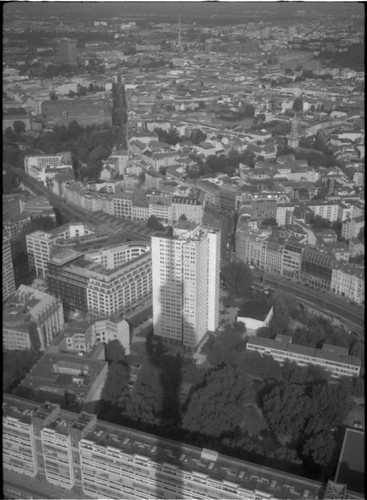
Ignoring Stephen Johnstone's advice, I didn't visit the Eiffel Tower until the third time I was in Paris. What is perhaps interesting about the Eiffel Tower is that its only function was as a huge viewing platform from which to gain a novel perspective on the city, much like the earlier panoramas. Originally temporary, it soon had an extra use when the new technology of radio appeared a few years later. Radio masts became a discrete architecture phenomenon of the early twentieth century, with notable examples in Berlin and Moscow. However, it was the development of microwave technology which provided the last great impetus for building tall structures in many cities around the world which were often open to the public for the purpose of viewing the city.


A couple of days ago, I visited the Kaknästornet in Stockholm. I had seen this from a distance when previously in Stockholm, on taking the ferry to Helsinki. The Kaknästornet makes no concessions to anything architectural other than pure utility. It was part of the 1960s glut of so-called TV towers, which were for telecommunications in general, but for the particular technological phase of microwave transmissions, that, unlike radio, need line-of-sight; this was just before satellite transmission began to supplement this role. These TV towers often became emblems of civic - or ideological - pride, such as the Fernsehturm in East Berlin, or the Post Office Tower in London, a symbol of the 'white heat' of technology. Now their aspirational qualities often have a kitsch, tacky edge to them, if indeed the towers are still open to the public, with sky-bars and revolving restaurants, which feel to represent the genuine, commonly held belief in the notion of 'progress'.


Sunday, 5 April 2015

Copenhagen to Stockholm

From Copenhagen to Stockholm the journey is a little over five hours by direct SJ X2000 tilting train. Rather than buy the ticket as a separate stage, I had actually bought a ticket from Hamburg to Stockholm. Booking with DB allows one to select a stop over of a number of hours for no extra cost - in this case twenty-four. As this journey would entail changing trains at Copenhagen anyway, by stopping overnight in Copenhagen I broke what would have been a rather long day on trains (around ten hours) by staying overnight. The Copenhagen to Stockholm train crosses the Öresund link - the bridge and the Drogden tunnel leading to it. Perhaps this is the future of the Puttgarden to Rodby route - almost but not entirely seamless crossing of borders. Between Copenhagen Airport Kastrup and Malmö, Swedish customs officers board the train. Having taken this route three times now, the customs officers only seem to ask passengers to indicate which bags are theirs. The SJ X2000 trains are generally very comfortable, ideal for a five hour journey (by contrast, the Eurostar trains are now looking a bit tired after twenty years), with free wireless internet, a good buffet car, with free refills on hot drinks. The only aspect that consistently seems to let the trains down are the toilets, which become quite messy and smelly as the journey time progresses: boarding the train at Copenhagen, it had already come from Fredericia a couple of hours away. It strikes me that the train does not contain enough toilets for the amount of passengers or the length of the journey.

One Hundred Years

Passing through north-western Europe on the Eurostar from London to Brussels, the train crosses the front line of 1915 a short distance east of Armentières. At school thirty years ago we were taught the song Mademoiselle from Armentières for a play about the First World War, possibly for the then seventieth anniversary of the conflict. For contemporary sensibilities, the lyrics - of which there are a few variants - would perhaps now be considered risque for ten-year-olds.

In May 2001 I travelled from London to Paris by train for the first time, and then on to Luxembourg. The train from Paris left on a late Spring afternoon, travelling east as the evening approached. At the time I thought about the fact that somewhere on this route the train would be passing through the sites of the First World War. It's a commonplace observation to make much of how the internet has changed lives in the developed world; once aspect of which has changed definitively is travel. In 2001 I went to the Air France/Rail France offices in Piccadilly to book my train tickets to Luxembourg, something not then possible online. Although I probably could have obtained detailed information on the stations that I passed through, and the route the train took, it was sufficient that I could get to Luxembourg in an afternoon. The long train stopped and divided at Metz. The time taken for this operation meant that I took a little more interest in the station than some of the others that we had passed through. The station had very long platform and imposing architecture which suggested it was of great importance. Only later did I discover that Metz was a station on the Kanonenbahn - the 'Cannons Railway', a strategic military route across Germany to France including areas annexed after the Franco-Prussian war, anticipating the next conflict. Now, thanks to online archives, it is possible to see trench maps from the First World War, and overlay these with the current rail routes (which are often the same lines as a hundred years ago) to see where front lines would have been.

Although the First World War was studied at both primary and secondary school I attended, there were no trips to see the battlefields and cemeteries of Northern France and Flanders. These school trips are seemingly rather more common now: my brother, sixteen years my junior, did do so, for example. After the cessation of hostilities, while the landscape of north-western Europe was still devastated, the first tours began:
"In 1919, only months after the end of the First World War, the first tourist guides to the battle fields were published. Both the French railway companies and Michelin, the motor-touring company, produced guidebooks full of maps and photographs of key landmarks. Strangely however, these publications refer to the same 'sights' as normal tourist guidebooks-churches, chateaux and town halls- albeit with the repeated caveats 'all that remains of...' or 'ruins of...'
Conflict Time Photography, eds. Simon Baker and Shoair Mavlian
At the time, the proximity of the war to the urban populations of Paris and London, and the scale of industrial destruction created a perfect spectacle. For non-combatants, any understanding of the nature of the conflict could perhaps only be realised by seeing the battlefields themselves. The Austrian writer Karl Kraus satirised these trips by mimicking the language of one actual prospectus in his Promotional Trips to Hell: the particular object of his satire is 'Battlefield Round Trips by Automobile organised by the Basel News':
"You leave from Basel on the evening express in second class carriages.
You are picked up at the Metz railway station and taken to the hotel by car.
You stay overnight in a luxury hotel - service and gratuities included.
You enjoy an ample breakfast.
You leave Metz in a comfortable automobile and are taken through the battlefield area of 1870-81
You are taken on a guided tour of the very interesting blockhouse at Etain [...]
You ride through destroyed villages to the fortress area of Vaux with its enormous cemeteries containing hundreds of thousands of fallen men.
You view with a guide the subterranean casemates of Fort Vaux.
You visit the Ossuaire (charnel house) of Thiamount, the continual depository of the remains of fallen men.
You get free admission to Fort Douaumont."
Kraus:
"You receive your newspaper in the morning.
You read how comfortable survival has been made for you.
You learn that 1 1/2 millions had to bleed to death in the very place where wine and coffee and everything else are included.
You have the decided advantage over those martyrs and dead men of first-rate accommodation and food in the Ville-Martyrs and at the Raven de la Mort.
You ride to the battlefield in a comfortable automobile, while those men got there in cattle cars.
You hear about all that is offered you by way of compensation for the sufferings of those men and for an experience whose purpose, meaning, and cause you have not been able to discover to this day.
You understand that it was organised so that some day, when nothing is left of the glory but bankruptcy, that there might at least be a battlefield par excellence."
Karl Kraus, Promotional Trips to Hell
Seven years later, Stefan Zweig approached the subject in an essay on Ypres. One assumes that he must have known Kraus' piece of invective, and the tone is occasionally similar:
"For ten marks you have it all: the entire four years of war, the graves, the huge guns, the shelled cloth-hall, with lunch or dinner, all comforts and a nice strong tea, conforming to the information displayed on every placard. Not a shop exists where they don't profit from the dead. They even offer curios made from shell splinters (perhaps these very same shells tore out the entrails of a human being), charming souvenirs of the battlefield,"
Stefan Zwieg, 'Ypres', in Journeys
For Zweig, the commercialisation of the the war seems to be the most troubling aspect, whereas with Kraus, it becomes an object of taste primarily. By the time Zweig wrote 'Ypres', the devastation of the war was already being brought into some kind of order, codified as a series of sacred landscapes, and he writes approvingly of the Menin Gate, the first of the Imperial War Graves Commissions monuments to missing soldiers. In 1919, to mark the first anniversary of the armistice in London, the Cenotaph was first constructed: there was felt the need for a focus for the ceremonial occasion. However this first Cenotaph was made of plywood, as a temporary memorial prior to the current one of stone. In recent years, since around 2000, memorials, mostly for aspects of the Second World War have proliferated in central London, partly to rectify perceived omissions in official remembrance, but, like recent events that have commemorated the outbreak of the First World War, these appear to be symbols whose importance is invested in their symbolic qualities themselves, rather than their referents: it feels the less a particular society believes in anything in common, the more need there is to bring it together for largely empty rhetorical gestures.

Writing seven years after Karl Kraus' Promotional Trips to Hell Stefan Zweig reaches a more generous conclusion in the section of the essay 'Ypres', titled 'Jamboree upon the Dead':
"Nevertheless: it is good that, in some places on this earth, one can still encounter a few horrifying visible traces of the great crime. Ultimately it is something good too when a hundred thousand people, comfortable and carefree, clatter through here annually, and whether they care for it or not, these countless graves, these poisoned woods, these devastated squares still serve as reminders. And all remembering for the most primitive, the most blasé natures, is somehow visual. All that recalls the past in whatever form or intention leads the memory back towards those terrible years that must never be unlearned."
 Stefan Zwieg, 'Ypres', in Journeys