Saturday, 18 April 2015

Endings

"After ten weeks' filming we were still only halfway through, though I'd aimed to finish the film in that time.There was no money to go on filming, and we were a long way short of an ending. The problem was: how should the journey end? Or: how might it be converted into a story? At first I thought of an accident. If it had been shot in America, it would certainly have finished with an accident. But thank God we weren't in America; we were free to do otherwise and get to the 'truth of our story'. Of course a film of that type can be literally neverending, and that's a danger. The solution, finally, turned out to be that the men would have to realize they couldn't go on like that; a break would have to come and they would have to change their lives."
Wim Wenders, 'Impossible Stories', in The Logic of Images
As described in the post on 'Ferries', Alice In The Cities ends with a shot of Alice and Philip on the train through the Rhine Valley to Munich, where Alice's mother has been found. Importantly, the film ends here, still in movement: there is no narrative need to depict the moment where mother and daughter are reunited. In the 'road movies trilogy', a sense of narrative resolution and the actual ending of each film do not coincide or cohere; while watching for the first time, the viewer does not know when the film may in fact end, and the point at which the film does end then retrospectively provides a sense of the resolution of the story within each film.

The only 'B-film' in the loose trilogy, in colour and based on a screenplay drawn from a literary source, The Wrong Move ends with Wilhelm, alone, having left behind the odd group of characters that he had accrued on his journey, on top of the highest mountain in Germany, his desire for experience, often vicarious, to make him a writer seems to have left a bitterness and inconclusiveness to his voice over at the point the film finishes. The spur for the break up of the group had been the industrialist's suicide. Peter Handke, who wrote the screenplay based on Goethe's Wilhelm Meister's Apprenticeship, interprets this ending with a note of positivity:
"Wilhelm Meister isn't really the hero at all. The heroes in the story are the individuals like the industrialist in his house, or the actress. Wilhelm attracts them to him, but only in order to get them to reveal something of themselves. They have far more courage and intensity than he does. He's just curious and rather invulnerable. He keeps saying he wants to write. One day he'll put down what he's seen. The heroes are the others."
Peter Handke, 'The Heroes Are The Others', in The Logic of Images
Kings Of The Road ends after Bruno and Robert fight at an abandoned border post, filled with graffiti from American soldiers, images from pornographic magazines and Coca-Cola bottles. Robert wakes up with a black eye. He gets out of the hut, urinates and leaves a note which reads: "Everything must change. So long. R." The film's story lasts as long as the two men are travelling together, from the moment that Bruno watches Robert's half-hearted attempt to kill himself by driving at high speed into a river, to their fight at the end of West Germany. A resolution of sorts is affected when both men confront something of their pasts. According the Wenders, these experiences improve their relationship, which paradoxically creates the situation for them to part: "They split up because, on their journey across Germany, they've suddenly grown too close. It's a story that you're not often told in films about men." (Wim Wenders, 'Kings of the Road', in The Logic of Images).

Robert arrives with his suitcase at a small railway station. There's a boy sitting, writing in a notebook:
"What are you writing?"
"I'm describing a station. Everything I see."
"And what do you see?"
"The tracks, the gravel, the timetable,
the sky, the clouds."
Robert picks up his suitcase which he has been carrying around for the duration of the film. It dangles on one finger.
"A man with a suitcase.
An empty suitcase.
A grin.
A black eye.
A fist.
Throwing a stone."
"It's as easy as that?"
"That easy!"
Robert swaps his sunglasses and the suitcase for the notebook. The scene then cuts to Bruno emerging from the hut, finding the note, walking towards the sign that demarcates the state border, and howling. He gets back into the truck. The film cuts to Robert, now on a train, apparently writing in the notebook he had swapped with the boy. The act of writing in Wim Wenders' films of the 1970s often accompanies a sense of accommodation for the characters who are writing: this may be a coming to terms with their past, or an aspect of their character, or Germany itself. Peter Handke believes that Wilhelm will write, "one day" - but this belongs to the future, outside of the film. In Alice in the Cities, Philip begins to write again once he has returned to Europe. Like Alice, the boy in Kings of the Road has the same clarity of vision. In Robert's conversation with him at the station, Wenders appears to be suggesting that the act of describing rather than telling is the medium's true strength. Through the window of the train, in a parallel movement, Bruno's truck is seen on the road. The viewpoint cuts from the train looking out to the truck, to the cab of the truck looking back at the train, as both keep pace with each other. Bruno is signing along to 'King of the Road'. As the train passes a level crossing where the truck is forced to stop, Bruno says, "Kamikaze, don't you think I haven't seen you!" From the train we then see Robert, quoting from something that Bruno said earlier in the film, "Getting by better and better eh?"

There than follows a brief coda, a bookend like the film's prologue, both showing Bruno talking to owners of the small-town cinemas that Kings of the Road is structured around. In the prologue this is an old man who was a silent film musician ("Those were tough days when the talkies came in.") In the coda, Bruno listens to a women in a cinema that's closed, but she wants to keep it ready for when the films return ("'Film is the art of seeing,' my father said", echoing Wenders himself). Bruno leaves the cinema, walking past the empty display cases where the imprints of long missing images show up on the faded backgrounds of 'this week's' and forthcoming films would be seen. A neon 'WW' is reflected in the windscreen as Bruno gets back into his truck, standing for the name of the cinema that is revealed as the camera pans away: Weisse Wand Lichtspiele. As well as the 'WW' only three of the letters of the sign are lit: the e and the nd.

Friday, 17 April 2015

Thursday, 16 April 2015

Other Viewpoints

"Every literary traveler has an habitual practice. [Norman] Douglas's is climbing up to an eminence whose height allows him to see something inaccessible to ground-dwellers."
Paul Fussell, Abroad
Stockholm's geology provides many interesting prospects. My copy of Hallweg's 1:15,000 map of the city shows five viewpoints, although this icon is not actually defined on the map's key. Three of these are located along the Northern edge of the island of Sodermalm, and two on Djurgården. Two of the five are buildings of a kind, the Katerinahissen and the Bredablick (a tower in Skansen: the name is literally 'broad-look' or view), and two are along the steep cliffs of the island. The fifth is in the Tivoli Gröna Lund, Although this amusement park was closed when I visited Djurgården to look for it, the viewpoint here can only be one (or more) of the rides. Three of the postcards recently drawn were from the viewpoints on Sodermalm. The Kaknästornet, as described in my post 'Panoramania', is not defined by such a symbol. The designation viewpoint is a value judgment by the cartographers, a reminder that maps are not a neutral display of geographic facts; that the Kaknästornet is not included makes it clear that there are of course other places in the city that the traveller may find panoramic views. The Kaknästornet is at a relative distance from much of the interest in central Stockholm that the other viewpoints provide, although its height and 360-degree views make it worth the entrance fee.


Having scrutinised the map of Stockholm, there are no viewpoints marked on Hallweg's similar map of Copenhagen. Copenhagen's geography is very different from Stockholm, but, as some viewpoints in the Stockholm map are not natural features (or at least are viewpoints from natural rises in the land significantly augmented by structures), it does feel anomalous that there are no similar designations in Copenhagen. The obvious candidates to be included would be some of the church spires that can be climbed, and the Rundetårn or 'Round Tower' in the centre of the city.


In the post 'Panoramania', I wrote about telecommunications towers in different cities as a symbol of technological progress and civic pride, many of which (although not all) members of the public can visit. Towers of different kinds had symbolic and other values in pre-modern cities, mostly being either religious in function or fortifications. The Round Tower in Copenhagen originally functioned as an observatory, as well as being attached to a church and university library; it is also open on a Monday, unlike many other attractions, a day that I was in Copenhagen on the route to St Petersburg. From the top of the tower it is possible on a clear day to see the route we would take the following day, across the Øresund Bridge to the indistinct shore of Sweden.

Wednesday, 15 April 2015

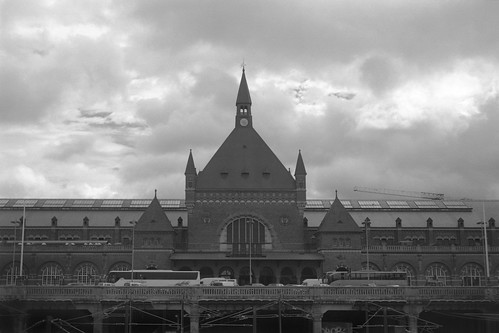
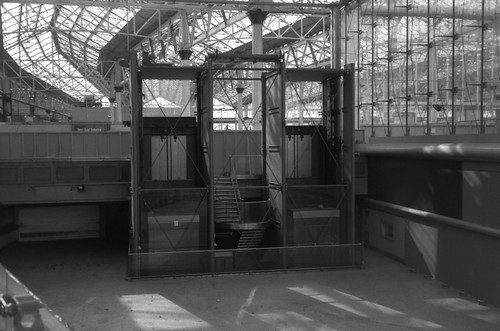
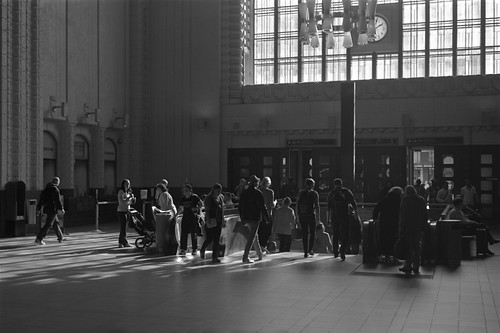
Some Thoughts On Railway Stations

“Like many others who have lived long in a great capital, she had strong feelings about the various railway termini. They are our gates to the glorious and the unknown.”
E. M. Forster, Howards End
Like Margaret Schlegel referred to in the quote from Howards End, having grown up in the suburbs of London, "the various railway termini" represented similar feelings for me, although rail travel had fallen out of grace during this period. The railway termini that had a hold on my imagination when younger were Liverpool Street and Waterloo, especially Waterloo, as this became the gateway to university life, just at the point that British Rail was broken up and privatised. To add to the "glorious and the unknown" of Waterloo, the Eurostar services began to run from the station in 1994; although our first year degree course trip went to Paris went by coach and ferry, two weeks later the Foundation Course also went to Paris, to the same hotel on the Boulevard du Magenta, by train.


Forster specifically defines the stations termini although he generalises "a great capital", which in Howards End is Edwardian London. London's main railway stations are of course all termini, due to factors in the historical development of the city's infrastructure, mainly the size of London itself when the railways were introduced to the city, making it a less than practical endeavour to lay tracks directly through the capital from one side to the other, as well as the factor of the railways being built by competing private companies. This situation is only now being changed by Crossrail. Other capital cities suffered from the same infrastructural complexities, notably Paris, also very large by the middle of the nineteenth century, and, like London, has the same arrangement of terminal stations in a ring around the centre. St Petersburg, as a planned eighteenth century city is the same. In smaller cities however, some that I have recently travelled through by train, Brussels, Cologne, Hamburg and Copenhagen, the main railways stations are of the type where the trains run straight through: the terminal station has an implication that the capital or other city is a natural destination rather than just a stop (other than old capital cities, terminal stations are most frequently found on the coast). This may, in some small measure, account for one aspect of the capital-centric economy of the United Kingdom.


Rail travel was one of the nineteenth century technologies that fractured space, along with advances in image reproduction, identified by Patrick Keiller in his relating Henri Lefebvre's ideas to early cinema, and quoted in my post The Phantom Ride. The great railway stations in Europe were designed with the necessity of steam, with the result that the high spans of the train shed roofs often brought comparisons to cathedrals. As a result, these stations were not built with an economy of space, which has meant for contemporary use these generous spaces can be re-purposed, and frequently filled with kiosks and shops, often on more than one level, maximising the footprint of the buildings. When no longer a necessity, these railway termini are also beautifully adaptable, being re-used for cultural purposes such as the Musee d’Orsay in Paris and the Hamburger Bahnhof in Berlin. The former cathedrals of the nineteenth century's new connectivity have become cathedrals of culture. Recent attitudes towards station architecture show a new or, perhaps more accurately, a renewed pride: from the low point of the rebuilt Euston Station, designed to be like an airport for the period when air travel being glamorously within reach of larger parts of the population, hiding the messy business of the trains themselves, to Berlin's new Hauptbahnhof and the renovated Kings Cross and St Pancras in London as just two recent examples.


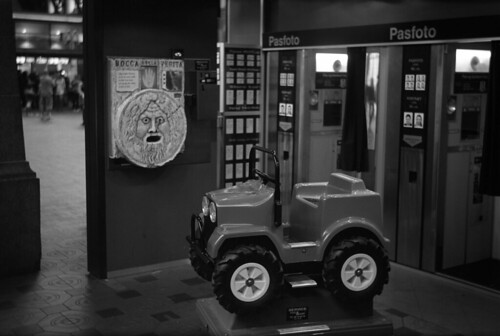
It is a truism to ascribe large, general similarities to airports around the world, a feature of post-war modernity, "subordinate pseudo-places" in Paul Fussell's words (tourist destinations are "pseudo-places" par excellence). By contrast, many large railway stations’ architecture is very particular, even vernacular, often from imperial periods in modern nation states' development, with stylistic reflections: Cologne’s steel arch with its glazed soaring lunettes either end (with neon names of brands associated with the city), Helsinki's distinct Baltic Style Moderne, Copenhagen’s double-vaulted wooden beamed roof, suggestive of an oversized medieval lodge. The Bocca Della Verita in Copenhagen Central that I had photographed in 2008 has gone from its position by the photo booths. I photographed the original in Rome four years earlier, the replica of it in Copenhagen was a fortune-telling machine for travellers to consult, oracle-like, before a journey.

Tuesday, 14 April 2015

Sketchbook

Moderna Museet, Stockholm 14/4/15


Monday, 13 April 2015

Ferries

"When you entered Manhatten by the Lincoln Tunnel twenty years ago [i.e. in 1960] you saw from the high west bank of the Hudson a vision that lifted your heart and in some measure redeemed the potholes and noise and lunacy and violence of the city. You saw the magic row of transatlantic liners nuzzling the island, their classy, frivolous red and black and white and green uttering their critique of the utility beige-gray of the buildings. In the row might be the Queen Mary or the Queen Elizabeth or the Mauretania, the United States or the America or the Independance, the Rafaello or the Michelangelo or the Liberté. These were the last attendants of the age of travel, soon to fall victim to the jet plane and the cost of oil and the cost of skilled labor."
Paul Fussell, Abroad
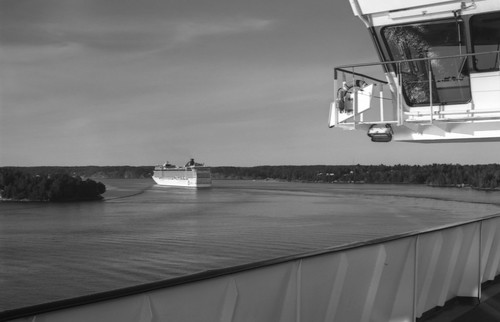
A number of years ago, I was commissioned to make some artwork for a cruise ship. A perk of this commission was that, many months later, when the ship docked in Southampton, the artists who had made work on board were invited to visit the ship while it was docked for the day. The ship was the size of a monstrous slab block of local authority housing, filling the terminal like a luxury hotel combined with a shopping centre. Inside, it gave the impression that it was anything but a sea going vessel, all the while insisting that this was in fact the case by being festooned with the symbols of maritime nature on almost every possible surface available for decoration. This also gave the ship's interior an appearance of, not so much opulence itself, but an idea of the opulence of sea-going travel, available, in reality, to relatively few people decades ago (there was certainly no steerage class on this ship, and travel by large ocean-going vessels is now very much a choice which reflects on those using it). The Baltic ferry from Stockholm to Helsinki taken on the route to St Petersburg felt very much a scaled down version of this, leading one to imagine that in the age of the "jet plane" and the budget airline, travel over the waves is largely an anti-utilitarian simulacra of that idea of a golden age that Paul Fussell was writing about.

Before the Channel Tunnel of course, the Channel ferry was the first glimpse of 'abroad' for those leaving England - or perhaps an interstitial space, neither home nor abroad. Unlike the huge cruise liner mentioned, or indeed the Baltic ferry, the Channel ferry never quite isolated its passengers from the reality of the means of transport. My earliest crossings to the Continent were by ferry, and, in the first instance, by hovercraft, like the telecommunications towers written about, a symbol of progressive technological advance now firmly stuck in the age when this was seen as symbolic of national pride - a future now gone. Although young, the main memory I have of the hovercraft was the aeroplane-style seating, the idea being that the crossing was to be so rapid that the passengers did not need to get up and move about for the duration. The hovercraft has been discontinued for many years. Later crossings were by more traditional ferry; when travelling to Paris by coach in 1994, I wrote that on the way there, we were not stopped at customs either at Dover or Calais, being waved, or waived, through on the coach itself. The return journey was not as pleasant: a customs official got on to the coach itself at Dover, and, after a student swore at her, we were all made to get off the coach and go through passport control individually. The coach driver, who had spent the duration of our stay in Paris drinking in the bar at the hotel, was rightly sarcastic about this as all the students got back on.


Taking the now-discontinued overnight ferry from Harwich to Esbjerg in Denmark some years ago, not knowing how easy it was to go through the boarding procedures, we got a train one hour earlier than needed, just in case, and as a result, had to wait in the tiny International terminal building in Harwich which has precious little facilities to speak of. There were very few foot passengers for the ferry, the security was simple, and one did not feel the weight of the state bearing down on the individual. Judging by the small amount of containers on board, the ferry did have some practical use in terms of imports and exports.

The resolution to Alice In The Cities occurs on a ferry across the Rhine. Having exhausted all leads in trying to find Alice's grandmother, after discovering that the house in Alice's photograph was now lived in by someone else, Philip decides to take Alice to his parents. At a kiosk beside the road, Philip finds a newspaper with a report in about Alice, but this is not acted upon. On the ferry across the Rhine, Alice asks Philip, "Are you looking forward to seeing your parents?" As the camera concentrates on the woman singing, accompanied by the boy who catches Alice's interest, sufficient to take a Polaroid photograph, we see the policeman that Philip and Alice had encountered in Wuppertal raising his sunglasses as he recognises them. He gets out of his car to approach Philip, saying that Alice's mother had been found. The few scenes that follow - Alice in the policeman's car, with Philip tailing them in his hired car; Alice giving Philip a hundred dollar bill "for your ticket"; and then the two of them on the train to Munich - are all a coda to this resolution of the quest to reunite Alice with her family, while still leaving the protagonists forever in movement, in the final shot of the two looking out of the train window as the aerial shot becomes ever higher and wider, seemingly in the camera's desire to encompass the whole of the Rhine valley.


Sunday, 12 April 2015

Picture Galleries

I was in Hamburg on a Monday. As seems a common convention in Northern European countries, the Hamburger Kunsthalle was closed. This may have been frustrating if I had the time to do anything other than get wet in my search for locations from The American Friend. On the trip from London to St Petersburg, we had 24 hours in Copenhagen - on a Monday. As a result, with culture shut for the day we went up the Round Tower, worth the small fee for the uniqueness of walking up a spiral ramp to the top, blessed with views all across the rooftops of the city - and, in the distance, the Oresund Bridge and the just visible outline of Sweden, the next day's journey by train. Returning from St Petersburg, we found ourselves in Helsinki on a Monday, with almost everything shut there.

Last week, in Copenhagen on a Wednesday, I went to the Statens Museum for Kunst. Enjoying their permanent collection (as well as an excellent temporary display on Durer's Triumphal Arch of Maxilimilian, shaming the British Museum's desultory display of the oversized print, for years badly lit next to the toilets), there was a realisation of the parochial qualities on institutions back in the UK which pretend otherwise: the National Gallery in London has very thin coverage of Northern European, specifically Scandinavian, painting. Of course, the National Gallery began as one man's collection, and represented the limitations one would expect; however, the idea that Italian painting, and specifically Italian Renaissance painting, was the pinnacle of the art persisted for many decades and perhaps is still informing acquisitions.

I arrived in Stockholm on this occasion in time for the Easter weekend. Certain things were shut, but some places ritually closed on a Monday were in fact open on Easter Monday - because this counted as Sunday for the purposes of opening times. However, the National Museum in Stockholm is currently undergoing major rebuilding work, so is closed (I did see the Denise Grunstein exhibition under the auspices of the National Museum at the Konstacademian; the most interesting of the photographs were those showing the backs of paintings from the National Museum, echoing the Cornelius Gijsbrechts painting in the Statens Museum in Copenhagen from the late seventeeth century of a back of a painting). I also visited the Thielska Galleriet. This is the house and collection of Ernest Thiel located at the far end of Djurgården. Most of the paintings, sculpture, drawings and prints were contemporary art from the decades immediately each side of 1900. Gifted to the state as a whole in 1924, it is the collection of one man, again, but the effect of the stasis of the collection as a capsule of taste is interesting: as well as those artists whose reputation has endured (Munch, Gaugin, Toulouse-Lautrec) or has increased (notably Vilhelm Hammershøi, represented by the large Five Portraits), it also includes artists whose reputations have dissipated since (I'm thinking of Anders Zorn, previously I've known Zorn from Lumsden's The Art of Etching; the collection having many etchings and some paintings, still popular in Sweden, but not more widely). Then there are the artists whose work remains largely unknown outside Scandinavian countries: Carl Larsson, Bruno Lilijfors, Gustav Fjaested, Karl Nordström, Esther Almqvist.

Two of the Karl Nordström charcoal drawings in the Thielska Galleriet concentrated on skies, taking up enough of the composition to be considered cloud studies; one of which featured just one large cloud. Having recently made a few paintings of clouds, as a means of making work free from many other concerns of subject matter that they felt as near to being just about painting itself as I can approach. Some of these paintings were based on photographs taken on the journey to St Petersburg; in the Hermitage, we saw a painting of a large cloud by Fyodor Vasilyev, which felt like a felicitous coincidence; the whole journey once leaving Copenhagen, through Sweden, the Baltic and Finland, was accompanied by bright and fine September weather. As well as the trompe l'oeil paintings by Gijsbrechts in the Statens Musuem For Kunst in Copenhagen this Spring, I also found some cloud paintings by  J. C. Dahl.

Saturday, 11 April 2015

Friday, 10 April 2015

A View from A Room

As briefly described in the post Writing on Trains, while taking my short excursion through Germany and Denmark, I was able to keep writing this blog mostly during the course of the various train journeys. Now in Stockholm for over a week, being static there is no longer the same propulsion to write with the cascade of new impressions; instead, a different set of impressions is created, not through novelty but by repetitions of now familiar rhythms.

Staying at Telefonplan, in the southern suburbs, the regular rhythms are the trains of the T14 Tunnelbana line - Stockholm's light rail system. Due to the landscape that the city is built upon, these trains frequently move from above ground to underground (as the name suggests) and back again. Directly outside the two windows of the room I am in, immediately parallel to the road this building is on, the railway line comes out of a cutting from Telefonplan station, bounded by a rocky outcrop on one side, and pass over a bridge crossing a road, before going into a tunnel into the hill bounding the horizon. This hill, with some apartment buildings among bare trees and some evergreens on the ridge, is just conceivably reminiscent of an Italian landscape, firs or pines standing in for cypresses, of the kind Northern European artists were seeking out in the late 18th and early 19th century (such as Thomas Jones or C. W. Eckersberg). This is the scene that I've drawn on two of the postcards. At different times of day, the trains' frequency changes, and during busy morning and early evening periods, the regular T-bana trains are joined by older rolling stock, announced by a slightly higher pitched whine. These blue trains have a near-generic look of many European cities' light rail trains, such as classic Paris Metro trains, older Berlin (or Hamburg) U-bahn trains - boxy, unstreamlined, with ridged metal panels, rounded corners to the narrow windows on the doors, individual seats, bare metal pillars and handles.

Although there was snow on the first morning after my arrival, the weather has turned fine since and the passing of the day is figured by the changing direction of the sun harshly back-lighting the scene during the height of the day, throwing the rocks and concrete of the embankment into sharp relief during the evenings with a parallel direction to the road and railway. A series of flags outside provide a regular snapping sound of ropes against poles in the wind.

The architecture at Telefonplan has an unadorned utility that is hard to date: large tall blocks of many floors with regular grids of windows, the brutal bare concrete tower that dominates the local skyline. Small details betray something of their age: the extensive use of terrazzo, for window sills as well as stairs, the small amount of wood in a few areas, and the tapered pillars outside. In the Spårvägsmuseet, Stockholm's transport museum, there was a display of photographs by Sven Goliath (1918-1989), which included a shot of Telefonplan from 1954, clearly showing the concrete tower and existing buildings very much as they are today. The whole complex which now includes offices, the art school, and accommodation and other services used to be the headquarters of Ericsson, and a bust of L. M. Ericsson stands on the corner diagonally opposite the station, next to one of the curious public telephones of the Rikstelefon with its odd flared lattice base. The main factory and office buildings were designed by Ture Wennerholm and built 1938-40; the 70 metre high tower was added after the Second World War, and designed by C. Dahl Steffensen. The tower is referred on the Swedish Wikipedia page about the Ericsson factory at Telefonplan to by the compound word kortvågsforskning, which translates as 'short-wave research' - this must be for microwave transmissions, the impetus behind the Kaknästornet written about under 'Panoramania'. The tower is not open to the public; however, opening a door at the end of a corridor on the top floor - the seventh floor - of the accommodation block, led into the adjoining building, into a stairwell that went as high as the 13th floor, halfway up the height of the Telefonplan tower opposite.


Thursday, 9 April 2015

Flea markets

Since being in Stockholm I have been to two of the local flea markets: the Sunday market at Hötorget, and the all-week around market, Loppmarknaden at Vårberg. The overall quality of the stalls at Hötorget was better, but the prices were much higher, and as a consequence, although I saw a number of items of interest, all were too expensive. At Loppmarknaden, which is an underground hall in the shopping complex attached to Vårberg station, some of the stalls were little more than just piles of household rubbish, and presented as such. The market charges an entry fee at weekends, but I went on a weekday. It's possible that it may be busier, and with more stalls at the weekend. There was a good deal of furniture and furnishings from the 1950s-60s-70s, which holds onto a use value for longer than items generally thought of as technology, where the turnover is more rapid: VHS players, portable CRT televisions, sterograms, many early digital cameras, game consoles and games, and whole boxes of remote controls and chargers.


The flea market neatly brings together the flaneur and the objet trouvé. London is poor in this regard, perhaps due to knowing the price of everything. In the UK, the car boot sale is the nearest native equivalent, yet the car boot sale rarely produces the same feelings of felicity and serendipity. Possibly at one time, the wares for sale could have said something specific about the society in which they are found (but these flea markets are becoming more universalised across different countries, which in itself suggests homogenisation) - by what society can't quite bring itself to throw away and eke some last monetary value from. One feels that some of this junk simply circulates.

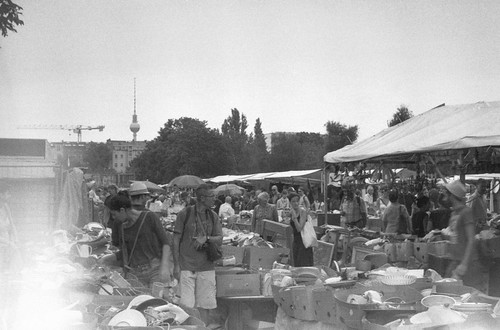
As usual, I was interested in cameras, photographic equipment and related items. There were many digital cameras from about a decade ago, a number of older SLRs, but the only camera that caught my eye, was an Agfa Isolette III. This looked in good condition, although a bit dusty, and everything worked except for the uncoupled rangefinder, which was stuck, and I may be able to repair this, but what piqued my interest sufficiently to buy it was the half-used roll of film inside. The seller wanted (and got) 200 SEK, just over £15. A few years ago I bought a Werra camera from the Mauerpark Flohmarkt in Berlin (the best flea market I have been to), which had a roll of half-used film inside. Despite opening the back and exposing the film, I was able to shoot the remaining film to get some images of the flea market on the camera I had just bought, and recover the undeveloped images, dormant for many years before the camera passed into my hands. Similarly, I finished the roll of film in the Isolette at Vårberg.


Wednesday, 8 April 2015

The Reisekamera

“Young Smith, the Secretary of our Photographic Club, called at nine to ask me to take him a negative of the statue of the dying Gladiator in the Munich Sculpture Gallery.  I told him that I should be delighted to oblige him, but that I did not intend to take my camera with me. “Not take your camera!” he said.  “You are going to Germany—to Rhineland!  You are going to pass through some of the most picturesque scenery, and stay at some of the most ancient and famous towns of Europe, and are going to leave your photographic apparatus behind you, and you call yourself an artist!” He said I should never regret a thing more in my life than going without that camera.”
 Diary of a Pilgrimage, Jerome K. Jerome
Photography has been intrinsically linked to travel since its very beginnings. The camera itself, before the invention of photography, was already in use as a travelling companion for artists and amateurs, cameras obscura being manufactured in portable versions, and the camera lucida appearing in 1807. An early amateur user of the camera lucida, William Henry Fox Talbot was frustrated with his lack of skill in drawing when attempting to make pictures at Lake Como in 1833. This European travel was a resumption of the idea of the aristocratic Grand Tour, made bourgeois, a benefit of the peace that followed the Congress of Vienna. Famously, he desired that the scene to be able to draw itself:
"...the idea occurred to me... how charming it would be if it were possible to cause these natural images to imprint themselves durably, and remained fixed upon the paper!"
William Henry Fox Talbot, The Pencil of Nature
Interestingly, he also used a camera obscura, with waxed paper to trace the utlines of an image upon; this works very differently from the camera lucida, which does not project the image, and the former device leads more directly to the invention of photography. Concurrently, in France, Niépce had made his own experiments, but conceived of photography primarily as a medium to reproduce existing works of art; Daguerre, who took up Niépce's work, had previously invented the diorama, a spectacular form of entertainment, noted for its changing lighting effects, that competed with the panorama - and, like the panorama, was capable of bringing distant lands to a sophisticated urban audience.

Despite all the technological difficulties of a truly mobile photography, from the beginnings of the wet plate photograph, the camera travelled - alongside a mobile darkroom. Glass plates had to be coated with a light-sensitive emulsion, and then exposed in the camera while this emulsion was still wet and subsequently developed. Photographic expeditions in the 19th century were very much in the mould of imperial explorations, with mule trains, handlers, camp equipment and such like, up to the point of the formulation of the dry plate. These could be bought from specialist manufacturers in bulk, exposed in the camera, then developed at leisure when the photographer returned. Shortly afterwards, towards the close of the 19th century, the Kodak camera was produced, and, together with flexible roll film, defined photography for much of the century to come. A symbol of the affinity between travel and photography was the fact that many cameras were named with such associations: the Reisekamera - literally "travel-camera" -  was an early, more mobile version of a studio plate camera. This idea became more prevalent as photography became increasingly available to the widest sections of society. There are at least five different cameras that use the word tourist in their names; four different traveler cameras (and one traveller);  a couple of explorers; the Russian Sputnik camera may have been named for the satellite, but 'sputnik' can be literally translated as "travelling companion"; and a great number of 'scout', usually box, cameras, with all the implications of camping and the outdoors.

The first time I used a camera, that I was given a camera to use - I presume I must have shown an interest in doing so - was in 1983, on holiday, camping in France. These very first photographs were taken with a Kodak Instamatic 50, making square photographs using the old 126 cartridge format (my mother had just been given a new 35mm SLR camera, and indeed, I'd forgotten about these early photographs for many years).


In Paris in 1994, with my then nearly new (to me) secondhand Praktica SLR, I shot five rolls of film, all black and white, the first negatives that I developed in the darkroom at my college on my degree. Looking back at the contact sheets, the images are (mostly) of subjects I would not now take photographs of - both the subjects, or their framings, specifically. There are lots of photographs of statuary, perhaps not surprising for my first experience of Paris. Notably, I went to the Louvre and didn't go to see any paintings at all, just sculpture. The sculpture stood in for missing human subjects, and the images ended up being used in photo-collages and etchings, including a series of photo-collages made at home over the Christmas break. I was also interested in the medium of the artist book at the time, which I made from original photographs, photocopies, and ephemeral material collected from the journey. However, these became exercises in empty aestheticism: I was looking to create complicated imagery that suggested meaning, without containing it. It was a lack of confidence that I could not let the photographs exist on their own merits.


In the years since I have always travelled with a camera. This in itself is not remarkable, especially now that almost everyone has some form of camera as part of a modern communication device. In Abroad, Paul Fussell uses the absence of photography as a distinguishing characteristic:
"...it is hard to be a snob and a tourist at the same time. A way to combine both roles is to become an anti-tourist. Despite the suffering he undergoes, the anti-tourist is not to be confused with the traveler [Fussell makes distinctions between explorers, travellers, and tourists]: his motive is not inquiry but self protection and vanity. [...] A useful trick is ostentatiously not carrying a camera. If asked about this deficiency by a camera-carrying tourist, one scores points by saying, "I never carry a camera. If I photograph things I don't really see them."
It is too simplistic to reduce experiences of looking in combination with photographing to the binary oppositions of the anti-tourist. For a time, perversely, I took a number of trips accompanied only by an old 35mm stereo camera. The severe limitations of using this format made sense for a time, but the camera wasn't very reliable. On more recent journeys I've taken a 35mm camera, a folding medium format camera, and some form of subminiature camera too.


Using film does mean not being able to see one's results immediately, usually not until after returning home. The photograph's function as an aide memoire is reinforced in the process of developing and revisiting images which may have been present in the viewfinder for a fraction of a second. Polaroids of course share a near-instantaneous aspect with digital photography: in Wim Wenders Alice In The Cities, Philip uses a Polaroid camera to photograph the surfaces of America, specifically the innovative SX-70, then relatively new, using integral film (not peel-apart negatives and positives which previous instant cameras used); Dennis Hopper in The American Friend photographs himself with a Polaroid. Leaving the development of film until later always provides an anxiety, however small, that something may go wrong with the film. Thus the undeveloped film is a precious cargo, a repository of memories and locations. On my journey through Brussels, Cologne, Wuppertal, Gelsenkirchen, Hamburg, Copenhagen and Stockholm, I've shot a number of rolls of film in all three formats. Their contents will reveal themselves in the course of time.


Tuesday, 7 April 2015

Postcards 2

Stockholm 4-6/4/15


Stories

When Alice and Philip alight from the Schwebebahn in Wuppertal, they find a hotel almost opposite the station entrance on Sonnborner Strasse. The girder of the Schwebebahn, which in this section is suspended above the road, lies directly outside of the window of the hotel room. A train goes past as Philip tells Alice when she has asked for a bedtime story, "I don't know any stories". Philip Winter, played by Rüdiger Vogler, in Alice In The Cities is introduced to the audience as a writer in the first part of the film, before he meets Alice and her mother, although he has been unable to write while in America; returning to Europe with Alice appears to provide inspiration and motivation for him to write. As Bruno Winter in Kings Of The Road, he repairs cinema projectors; Philip Winter returns as a private detective several years later in Until The End Of The World and Faraway, So Close!, and finally as a sound engineer in Lisbon Story. It might be fair to assume that Rüdiger Vogler stands in for Wim Wenders (even as a different character - to match his different occupations as Winter - in the middle film of the 'road movies trilogy', The Wrong Move), not as an alter ego perhaps, but something of a specifically German everyman, born into the same 1940s generation as Wenders, who came of age in a divided Germany in the 1960s.

After announcing that he knew no stories, Philip relents and begins, ”Once there was a man" but after an interruption he corrects himself and starts again: "Once there was a little boy who got lost”. Each 'figure' in Philip’s story - like a musical figure - passes in succession, seemingly with only its linear sequence to connect it with the statement before, which has echoes of the structure of the road movie itself: "and then..." - "and then" Alice asks when there is a pause. This emphasises the clear storyness of the story, its episodic motifs tumbling past each other as Philip improvises its forward movement long enough for Alice to fall asleep. The soundtrack theme by Can re-appears and Philip closes the window to mute the sound of the Schwebebahn.

Since the hugely successful Paris, Texas, it sometimes feels that the stories are imposed on Wim Wenders films: in contrast, with the best of his films from the 1970s, the story, or the narrative, was rather more contingent on character and location, even with those films with external sources, his 'B-films': The American Friend's Jonathan Zimmermann in Hamburg, or Wilhelm Meister moving through 1970s West Germany in The Wrong Move. In later films, character and location become subservient to the narrative - Wings Of Desire being a case in point: despite its reputation, with its self-defining seriousness, it has none of the sure lightness of touch that makes Alice In The Cities such a joy. Despite a few directorial mis-steps, Lisbon Story, a later exception, touches these contingencies again. In recent years, Wenders is more happy as a documentarian: here, the material can be shaped from the outside, rather than from the inside in a fictional narrative.

On the train to St Petersburg nineteen months ago, as passengers' travel documents were checked by passport and customs controls, the man seated at our table, who had pronounced crossing the border, "very John le Carre", told us the bare outline of a fascintating story:
"The train stops at Vyborg. Russian customs (in green) and passport/visa control in black, with forage caps and all that we saw were female. The passenger sitting adjacent, next to T- proffered the information that he used to live here, in Vyborg, that it wasn't a very Russian city, having been Finnish and under Swedish control. [We later saw that he had a Norwegian passport and spoke fluent Russian to the customs officials.] He told us that he had met a woman about ten years ago, who was 113, living in a Soviet era apartment with her daughters, in their eighties. She had been married and had a family before the Russian Revolutions of 1917. She had been a prisoner of war [in the second world war] captured by the Germans, and had been in a camp in Kaliningrad. He said that it had been [a] German [city and he couldn't think of the name]. I was able to offer that it had been known as Königsberg. He said that she had told him at the end of the war she had walked home to Vyborg "on her own two legs". He had said he'd asked her if she had any photographs, documentation of this remarkable journey. She had said that photographs were the last thing on her mind."
Later, the man went to the buffet car saying something along the lines of the fact that one could always find better company there - I think we weren't convivial or gregarious enough fellow passengers for him. The short few sentences about the 113-year old woman were bound up with a century's worth of upheavals in ideology, history and nation states themselves. Vyborg, where the train was stopped, had been Viipuri when Finnish, which it had been when this woman would have been born in 1890. As part of the Grand Duchy of Finland, it was ruled by the Tsar, but with a relative amount of autonomy; it then became part of an independent Finland after the civil war following the revolutions of 1917. After the Winter War, the Soviets captured and annexed Vyborg; it then briefly returned to Finnish control with the Continuation War, and finally became part of the Soviet Union once again, and was recognised as such with the Moscow Peace Treaty.

The location where the woman had been held as a prisoner of war had a similarly complicated twentieth century history. Königsberg was the major city of East Prussia, and at the beginning of the century this was a contiguous part of Germany itself, seat of the Hohenzollerns who became the emperors of a united Germany. After the First World War, this became an enclave, cut off from Germany by the Polish corridor, which stretched across former Prussian lands to the Baltic Sea. At the end of the Second World War, the victorious Allies determined to simplify the map of Europe by forcing the mass migration of Germans into the redrawn boundaries of post-war Germany, a form of ethnic cleansing designed to forestall any future conflicts of expansion. East Prussia was ceded to the Soviet Union and its German identity erased. Königsberg became Kaliningrad, and by an irony of fate, with the fall of the Soviet Union, Kalinigrad Oblast became an enclave once again, remaining Russian, while now surrounded by the EU countries of Poland and Lithuania
"There is something extraordinary about the decision of the Allied control council, in February 1947, to abolish the state of Prussia by an act of law. Unlike most laws issued by the council, this one has a miniature history lesson in the preamble. It says Prussia, which had since times of yore been the seat of reaction and militarism, is hereby demolished. The explanation for the law is in its wording. The state is seen as the source of militarism and reaction in German history and for that reason it has to be exorcised from the European map. It is an unquiet spirit that must be dispelled."
Christopher Clark, quoted in Neil MacGregor, Germany: Memories of a Nation
Living in the United Kingdom, an island with 'natural' geographical borders, although with the contentions of Ireland and to a lesser degree Scotland, brings with it a sense of national identity that does not necessarily need to be questioned. It is hard therefore to imagine what it may be like to live in contested lands, especially in the last century or so of the nation state - essentially a recent concept, but one that it would be difficult to conceive of a world without: in certain parts of Europe boundaries and allegiances have changed numerous times in the last one hundred years. However, with closer integration within the EU, perhaps regional identities - within being 'European' - will begin to feel more important than national identities, much as a writer like Stefan Zweig may have felt before the outbreak of the First World War.

As light relief, in Jerome K. Jerome's Diary of A Pilgrimage, he recounts being stuck in a train carriage with a very talkative man, who tells a long story about a dog, which remained undefined by its shagginess or not, but this feels knowing:
“After the dog story, we thought we were going to have a little quiet.  But we were mistaken; for, with the same breath with which he finished the dog rigmarole, our talkative companion added: “But I can tell you a funnier thing than that—” We all felt we could believe that assertion.  If he had boasted that he could tell a duller, more uninteresting story, we should have doubted him; but the possibility of his being able to relate something funnier, we could readily grasp. But it was not a bit funnier, after all.  It was only longer and more involved.  It was the history of a man who grew his own celery; and then, later on, it turned out that his wife was the niece, by the mother’s side, of a man who had made an ottoman out of an old packing-case.”
Jerome K. Jerome, Diary of a Pilgrimage

Monday, 6 April 2015

Postcards 1

From London to St Petersburg, 2013


Panoramania

Just before our first year college trip to Paris, in November/December 1994, the normal Monday morning lecture was put aside. Reading my diary from Monday 28th November 1994, I described it as:
"We didn't have a lecture as such, rather Stephen Johnstone talked us through some slides, giving general advice about the trip, telling us what to avoid [I seem to remember advice not to go anywhere near Pigalle], how to look less like a British tourist than we inevitably will, but mainly went through the gamut of exhibitions that, all of which we are supposed to find time to see. Of course, Robert Radford had to prompt him to mention his (Stephen's) [with Graham Ellard] own piece in an exhibition in the Pompidou Centre." [I did go to see this piece, though only mentioned the fact that I did without passing comment.]
I recall Stephen Johnstone talking about the need to go up tall things - both the Eiffel Tower, of course, and the Pompidou Centre, then still relatively new - to make sense of the topography a new city, a distinctly self-conscious experience of urban modernity. This has become conflated with the panorama in my memory, a different 19th century phenomenon. There was a book titled Panoramania!, by Ralph Hyde, which came out in 1988 - did Stephen Johnstone show a slide of the cover image, which feels familiar enough to be a genuine memory, during the lecture?

The first panorama to be exhibited in Germany was Robert Barker’s Panorama of London from 1792, shown in Hamburg in 1799 in a specially built octagonal wooden structure in the New Market. This panorama, a first major success for Barker, was a 360-degree view of the city, and was first exhibited in London. Four years later a panorama of Hamburg appeared in Hamburg itself, followed by a second in 1806: “Now our city, too has finally “arrived” and may see its own walls reproduced, thanks to the skill and three-year effort of an artist from Milan by the name of Taragniola” - The Nordische Miscellen, quoted in Stephen Oetterman, The Panorama; this panorama was not apparently very popular, and four years later the same artist produced a new version displayed at the rotunda at the Reeperbahn (which has originally been showing a panorama of Vienna). The building on the Reeperbahn was destroyed by French troops in 1814. Altona, now entirely subsumed by the city of Hamburg, had its own panorama by Jess Bundsen between 1818-1823.

Historically, the panorama was a new, immersive form of pre-cinematic visual entertainment. With many travelling panoramas being able to bring far cities near, or battle scenes, it is a notable feature that most often a panorama of a particular city would be exhibited in that city itself. This suggests that the viewers of these panoramas were most impressed by the spectacle of the technology, especially when these panoramas featured views that for most of their public would have been easily accessible - such as the panorama of London made from the top of St Paul's Cathedral. However, there were still many notable panoramas showing distant locations or battles to an interested public. In The View From The Train, Patrick Keiller writes about the beguiling aspects of the city and street webcams that began to appear in the early days of the spread of the internet, and their possibilities of fracturing space, a concern of Keiller's, and also their often unmediated qualities. In the age of Google Street View, these static, low resolution, low refresh-rate cameras feel like an odd, nearly forgotten niche survival from early net idealism. Nevertheless, before leaving London, I did view a number of sites featuring these municipal cameras, just to get an idea of weather conditions in Hamburg and Stockholm. Street View itself is much more instrumental in its design, but as previously written about, a number of places in German cities were either not covered by it, or blocked, blurred out. One wonders whether this may in part be due to memories of regimes with deep surveillance programs.

Ignoring Stephen Johnstone's advice, I didn't visit the Eiffel Tower until the third time I was in Paris. What is perhaps interesting about the Eiffel Tower is that its only function was as a huge viewing platform from which to gain a novel perspective on the city, much like the earlier panoramas. Originally temporary, it soon had an extra use when the new technology of radio appeared a few years later. Radio masts became a discrete architecture phenomenon of the early twentieth century, with notable examples in Berlin and Moscow. However, it was the development of microwave technology which provided the last great impetus for building tall structures in many cities around the world which were often open to the public for the purpose of viewing the city.


A couple of days ago, I visited the Kaknästornet in Stockholm. I had seen this from a distance when previously in Stockholm, on taking the ferry to Helsinki. The Kaknästornet makes no concessions to anything architectural other than pure utility. It was part of the 1960s glut of so-called TV towers, which were for telecommunications in general, but for the particular technological phase of microwave transmissions, that, unlike radio, need line-of-sight; this was just before satellite transmission began to supplement this role. These TV towers often became emblems of civic - or ideological - pride, such as the Fernsehturm in East Berlin, or the Post Office Tower in London, a symbol of the 'white heat' of technology. Now their aspirational qualities often have a kitsch, tacky edge to them, if indeed the towers are still open to the public, with sky-bars and revolving restaurants, which feel to represent the genuine, commonly held belief in the notion of 'progress'.


Sunday, 5 April 2015

Copenhagen to Stockholm

From Copenhagen to Stockholm the journey is a little over five hours by direct SJ X2000 tilting train. Rather than buy the ticket as a separate stage, I had actually bought a ticket from Hamburg to Stockholm. Booking with DB allows one to select a stop over of a number of hours for no extra cost - in this case twenty-four. As this journey would entail changing trains at Copenhagen anyway, by stopping overnight in Copenhagen I broke what would have been a rather long day on trains (around ten hours) by staying overnight. The Copenhagen to Stockholm train crosses the Öresund link - the bridge and the Drogden tunnel leading to it. Perhaps this is the future of the Puttgarden to Rodby route - almost but not entirely seamless crossing of borders. Between Copenhagen Airport Kastrup and Malmö, Swedish customs officers board the train. Having taken this route three times now, the customs officers only seem to ask passengers to indicate which bags are theirs. The SJ X2000 trains are generally very comfortable, ideal for a five hour journey (by contrast, the Eurostar trains are now looking a bit tired after twenty years), with free wireless internet, a good buffet car, with free refills on hot drinks. The only aspect that consistently seems to let the trains down are the toilets, which become quite messy and smelly as the journey time progresses: boarding the train at Copenhagen, it had already come from Fredericia a couple of hours away. It strikes me that the train does not contain enough toilets for the amount of passengers or the length of the journey.

One Hundred Years

Passing through north-western Europe on the Eurostar from London to Brussels, the train crosses the front line of 1915 a short distance east of Armentières. At school thirty years ago we were taught the song Mademoiselle from Armentières for a play about the First World War, possibly for the then seventieth anniversary of the conflict. For contemporary sensibilities, the lyrics - of which there are a few variants - would perhaps now be considered risque for ten-year-olds.

In May 2001 I travelled from London to Paris by train for the first time, and then on to Luxembourg. The train from Paris left on a late Spring afternoon, travelling east as the evening approached. At the time I thought about the fact that somewhere on this route the train would be passing through the sites of the First World War. It's a commonplace observation to make much of how the internet has changed lives in the developed world; once aspect of which has changed definitively is travel. In 2001 I went to the Air France/Rail France offices in Piccadilly to book my train tickets to Luxembourg, something not then possible online. Although I probably could have obtained detailed information on the stations that I passed through, and the route the train took, it was sufficient that I could get to Luxembourg in an afternoon. The long train stopped and divided at Metz. The time taken for this operation meant that I took a little more interest in the station than some of the others that we had passed through. The station had very long platform and imposing architecture which suggested it was of great importance. Only later did I discover that Metz was a station on the Kanonenbahn - the 'Cannons Railway', a strategic military route across Germany to France including areas annexed after the Franco-Prussian war, anticipating the next conflict. Now, thanks to online archives, it is possible to see trench maps from the First World War, and overlay these with the current rail routes (which are often the same lines as a hundred years ago) to see where front lines would have been.

Although the First World War was studied at both primary and secondary school I attended, there were no trips to see the battlefields and cemeteries of Northern France and Flanders. These school trips are seemingly rather more common now: my brother, sixteen years my junior, did do so, for example. After the cessation of hostilities, while the landscape of north-western Europe was still devastated, the first tours began:
"In 1919, only months after the end of the First World War, the first tourist guides to the battle fields were published. Both the French railway companies and Michelin, the motor-touring company, produced guidebooks full of maps and photographs of key landmarks. Strangely however, these publications refer to the same 'sights' as normal tourist guidebooks-churches, chateaux and town halls- albeit with the repeated caveats 'all that remains of...' or 'ruins of...'
Conflict Time Photography, eds. Simon Baker and Shoair Mavlian
At the time, the proximity of the war to the urban populations of Paris and London, and the scale of industrial destruction created a perfect spectacle. For non-combatants, any understanding of the nature of the conflict could perhaps only be realised by seeing the battlefields themselves. The Austrian writer Karl Kraus satirised these trips by mimicking the language of one actual prospectus in his Promotional Trips to Hell: the particular object of his satire is 'Battlefield Round Trips by Automobile organised by the Basel News':
"You leave from Basel on the evening express in second class carriages.
You are picked up at the Metz railway station and taken to the hotel by car.
You stay overnight in a luxury hotel - service and gratuities included.
You enjoy an ample breakfast.
You leave Metz in a comfortable automobile and are taken through the battlefield area of 1870-81
You are taken on a guided tour of the very interesting blockhouse at Etain [...]
You ride through destroyed villages to the fortress area of Vaux with its enormous cemeteries containing hundreds of thousands of fallen men.
You view with a guide the subterranean casemates of Fort Vaux.
You visit the Ossuaire (charnel house) of Thiamount, the continual depository of the remains of fallen men.
You get free admission to Fort Douaumont."
Kraus:
"You receive your newspaper in the morning.
You read how comfortable survival has been made for you.
You learn that 1 1/2 millions had to bleed to death in the very place where wine and coffee and everything else are included.
You have the decided advantage over those martyrs and dead men of first-rate accommodation and food in the Ville-Martyrs and at the Raven de la Mort.
You ride to the battlefield in a comfortable automobile, while those men got there in cattle cars.
You hear about all that is offered you by way of compensation for the sufferings of those men and for an experience whose purpose, meaning, and cause you have not been able to discover to this day.
You understand that it was organised so that some day, when nothing is left of the glory but bankruptcy, that there might at least be a battlefield par excellence."
Karl Kraus, Promotional Trips to Hell
Seven years later, Stefan Zweig approached the subject in an essay on Ypres. One assumes that he must have known Kraus' piece of invective, and the tone is occasionally similar:
"For ten marks you have it all: the entire four years of war, the graves, the huge guns, the shelled cloth-hall, with lunch or dinner, all comforts and a nice strong tea, conforming to the information displayed on every placard. Not a shop exists where they don't profit from the dead. They even offer curios made from shell splinters (perhaps these very same shells tore out the entrails of a human being), charming souvenirs of the battlefield,"
Stefan Zwieg, 'Ypres', in Journeys
For Zweig, the commercialisation of the the war seems to be the most troubling aspect, whereas with Kraus, it becomes an object of taste primarily. By the time Zweig wrote 'Ypres', the devastation of the war was already being brought into some kind of order, codified as a series of sacred landscapes, and he writes approvingly of the Menin Gate, the first of the Imperial War Graves Commissions monuments to missing soldiers. In 1919, to mark the first anniversary of the armistice in London, the Cenotaph was first constructed: there was felt the need for a focus for the ceremonial occasion. However this first Cenotaph was made of plywood, as a temporary memorial prior to the current one of stone. In recent years, since around 2000, memorials, mostly for aspects of the Second World War have proliferated in central London, partly to rectify perceived omissions in official remembrance, but, like recent events that have commemorated the outbreak of the First World War, these appear to be symbols whose importance is invested in their symbolic qualities themselves, rather than their referents: it feels the less a particular society believes in anything in common, the more need there is to bring it together for largely empty rhetorical gestures.

Writing seven years after Karl Kraus' Promotional Trips to Hell Stefan Zweig reaches a more generous conclusion in the section of the essay 'Ypres', titled 'Jamboree upon the Dead':
"Nevertheless: it is good that, in some places on this earth, one can still encounter a few horrifying visible traces of the great crime. Ultimately it is something good too when a hundred thousand people, comfortable and carefree, clatter through here annually, and whether they care for it or not, these countless graves, these poisoned woods, these devastated squares still serve as reminders. And all remembering for the most primitive, the most blasé natures, is somehow visual. All that recalls the past in whatever form or intention leads the memory back towards those terrible years that must never be unlearned."
 Stefan Zwieg, 'Ypres', in Journeys

Saturday, 4 April 2015

Writing on trains


Although a number of the pieces on this blog were researched and drafted before leaving London, many were written or edited during the five days of travelling around on trains. At hotels, all of which had wireless internet, I was able to post using a Kindle, although its 'experimental browser' meant that these were written in HTML rather than 'compose' mode. The X2 542 train from Copenhagen to Stockholm also had free wireless, and the five-hour journey could be spent working on this blog. The majority of the actual writing was done initially by hand - on whatever came to hand, which meant tickets and schedules and maps.

Hamburg to Copenhagen


Indirectly, what prompted my visits in search of Wim Wenders was looking for an alternative route to Stockholm. Eighteen months ago, I had travelled with my partner from London to St Petersburg, and the route had taken the now-discontinued City Night Line sleeper service from Cologne to Copenhagen. This route can be taken on ICE trains during the day, but, with many overnight services being cut back, I was looking for something as unusual. This was how I found the Puttgarden to Rødby train ferry, via The Man In Seat 61 website, which serves the Hamburg to Copenhagen ICE 33 route. There are many fewer such services than there used to be, and there have been plans to replace the ferry with a fixed link for more than thirty years, initially with a bridge, more recently with an immersed tunnel; the current projected date for this is 2021. This will cut journey times by an hour and a half. However, since the end of the Cold War, it has been argued that such a huge civil engineering project could better serve important routes further East, such as from Rostock to Gedser.

The ferries which serve this route cross the 18-kilometre Fehmarn Strait of the Baltic in forty-five minutes, from the German island of Fehmarn to the Danish island of Lolland; these are connected to either mainland by a bridge and tunnel respectively. There are six train crossings each way daily, although the ferries themselves run twenty-four hours a day, departing every half an hour. After stopping at Puttgarden station, the four carriage train is driven straight onto the bottom deck of the ferry, across the roadway and a lowered ramp, sharing this deck with lorries and coaches. Cars have the deck above. There are four actual ferries: the one I was on was the Prins Richard.


Once the train is loaded on the ferry, passengers are required to disembark and the train is locked for the duration of the crossing, meaning that bags can be left on board. The ferry has a couple of decks for passengers above those for vehicles, with all the amenities one might expect: duty free shops, a cafe, a 'Trucker's Lounge', a 'Panorama Lounge' at the front for views of the crossing. Having been on the train while the ferry was loading, I didn't get a sense of how many vehicles were on board (I could see the cars driving up the ramp to the deck above as we rolled on), and on the train deck, the train itself forms one side of a corridor with a service core containing stairways and lifts on the other, so there wasn't much to see when disembarking. I spent most of the crossing on board the decks outside. With a strong wind and the remnants of the weather system that had provided all the rain I'd experienced the past three days, there was a little roll to the ferry's forward motion, slight, but deceptive. Most of the passengers outside were either taking photographs or smoking. As the ferry docks, passengers are required to return to the train - or their vehicles - and the train rolls into Rødby Faraege station for the onward journey.

As Euroroute 47, this important transport corridor is also known by a name that reflects its position on a route for migrating birds: the Vogelfluglinie, or 'bird-flight-line'.


Friday, 3 April 2015

Baedekers

One of the set texts that I studied for A-level English Literature was E. M. Forster’s Howards End. I have a distinct memory of the silence that was the response when the class was asked what a Baedeker was. Having recently re-read Howards End, I cannot find such a reference to the eponymous guidebooks published by Karl Baedeker and his sons. It may have come up in discussion of the context of the book, an Edwardian ‘state of the nation’ work after the previous two ‘Baedeker’ novels, Where Angels Fear To Tread and A Room With A View, both of which have significant sections set in Italy, an essential part of the education of certain English classes at the time - and both of which mention Baedeker by name.  Although one of the main characters leaves England in Howards End, the action in the novel firmly remains in England. In Where Angels Fear To Tread, Forster creates a fictitious entry for the town of Monteriano in Baedeker’s "Central Italy" (looking at examples online, the Baedekers for Central Italy are titled specifically Central Italy and Rome).

During the summer after my A-levels, I spent most of my time either reading or drawing. Early summer had been hot and sunny, but July turned rainy, and, having studied Howards End, I read all of Forster's other novels, a couple of them in a day, and his short stories (other readings were Conrad's short stories in their hardback Everyman editions, and a large volume of Edgar Allan Poe). In Howards End, published in 1910, Forster's perspective on Germany feeds into a history for the Schlegels: their father left the Germany he loved through seeing it becoming distorted as a result of Bismarck's unification: "It was his hope that the clouds of materialism obscuring the Fatherland would part in time, and the mild intellectual light re-emerge".

Looking at Baedekers from the period before the First World War, when Forster wrote all his novels except A Passage To India, among the books' notable approaches is the way that they are laid out: they are written in routes. Prior to air travel fundamentally changing an appreciation of physical space, travel could not escape contiguity: the only way to reach a destination was by moving through the landscape from one's point of origin. Therefore, a guidebook to one particular place - even though this might be the destination -  made less sense in a world confined to surface travel in a linear fashion. Travellers would naturally have an interest in negotiating the spaces and modes of transport in between, and before faster trains, reaching cities in the continent from England would entail several days' duration, so places to stay at nodal points along these linear routes were also of interest. Thus, tracing the routes in Baedeker's The Rhine and Northern Germany (1870), my journey to Wuppertal encompasses:
[Route] 1. From Brussels to Cologne.

By Express in 6 1/2 hrs.; fares 27 fr. 75, 20 fr. 50 c. Custom-house formalities at Cologne (or at Aix-la-Chapelle , if the traveller proceeds no farther). Finest views between Louvain and Liège to the right. District between Liège and Aix-la-Chapelle replete with interest. 
[Then Route 42 from Cologne to Düsseldorf.
[Route] 47. From Düsseldorf to Cassel.

Express in 8 3/4, ordinary trains in 13 hrs.; fares 7 Thlr. 25, 5 Thlr. 18, 3 Thlr. 25 Sgr. District as far as Dortmund and beyond Paderborn picturesque and industrial; structure of the line itself an object of interest. From the convent of Gerresheim (first stat[ion]., fine church of the 12th cent.), Archbishop Gebhard of Cologne abducted the beautiful Countess Agnes of Mansfeld. After passing Erkrath (hydropathic estab.), the train ascends to Hochdahl (large iron-foundry of Eintracht), 494 ft. higher than Düsseldorf.

[...]

Vohwinkel (see above) is a junction of the Prince William line (Steele-Vohwinkel), principally used for the coal traffic.

From Vohwinkel to Steele in 1/4 hr.; fares 27, 20, 13 Sgr. —
Beyond stat[ion]. Aprath the line crrosses the watershed between the Wupper and the Ruhr, and then follows the valley of the Deile. Stat[ion]. Neriges, a resort of pilgrims, with an old chateau; stat[ion]. Langenberg possesses several thriving silk factories. At stat[ion]. Kupferdreh the Ruhrthal is suddenly entered, presenting a striking and picturesque contrast to the narrow sinuosities of the Deilethal. Numerous coal-mines are passed. Where the train crosses the Ruhr, a pleasing glimpse of the valley is obtained. 
[...]

At Sonnborn the train suddenly enters the valley of the Wupper, traverses it, then skirts the hill-side, commanding a view of Elberfeld below.

Elberfeld [...], pop. 65,321 (12,000 Rom. Cath.), and the adjoining town of Barmen [...], with 64,945 inhab., together form a series of streets nearly 6m. in length, intersected by the road, railway, and the Wupper, which is the principal source of the industry of this district. With the exception of some English towns, there is probably no spot in the world so densely populated. Its principal manufactures are cotton, silk, ribbon, and turkey-red dyed goods. Some of the churches and public edifices are handsome, but, like the towns themselves, of very modern date.
Elberfeld and Barmen, already physically joined at this date, would become Wuppertal ("Wupper-Valley") in a referendum of 1930. I haven't calculated how long the whole journey would have taken, but in 1870, Brussels to Cologne - by express - took six and a half hours. My train was 1 hour and 47 minutes. Wuppertal's principal 'manufacture' is now pharmaceuticals: the giant Bayer factory spreads the distance of a few stops of the Schwebebahn.

Forster's characters embody differing perspectives on the ubiquitous Baedeker. In Where Angels Fear To Tread it is seen as an essential source of information, as it is also seen by Lucy in A Room With A View: “Taking up Baedeker's Handbook to Northern Italy, she committed to memory the most important dates of Florentine History. For she was determined to enjoy herself on the morrow”; meanwhile Eleanor Lavish, the novelist, is dismissive: "I hope we shall soon emancipate you from Baedeker. He does but touch the surface of things. As to the true Italy—he does not even dream of it. The true Italy is only to be found by patient observation." and:
"Lucy, who wanted to see Santa Croce, suggested, as a possible solution, that they should ask the way there. 'Oh, but that is the word of a craven! And no, you are not, not, NOT to look at your Baedeker. Give it to me; I shan't let you carry it. We will simply drift.'"
E. M. Forster, A Room with a View
Eleanor Lavish, who, by drifting, in this scene effects another meeting between Lucy and the Emersons, is a Situationist avant le lettre.