Wednesday, 15 April 2015

Some Thoughts On Railway Stations

“Like many others who have lived long in a great capital, she had strong feelings about the various railway termini. They are our gates to the glorious and the unknown.”
E. M. Forster, Howards End
Like Margaret Schlegel referred to in the quote from Howards End, having grown up in the suburbs of London, "the various railway termini" represented similar feelings for me, although rail travel had fallen out of grace during this period. The railway termini that had a hold on my imagination when younger were Liverpool Street and Waterloo, especially Waterloo, as this became the gateway to university life, just at the point that British Rail was broken up and privatised. To add to the "glorious and the unknown" of Waterloo, the Eurostar services began to run from the station in 1994; although our first year degree course trip went to Paris went by coach and ferry, two weeks later the Foundation Course also went to Paris, to the same hotel on the Boulevard du Magenta, by train.


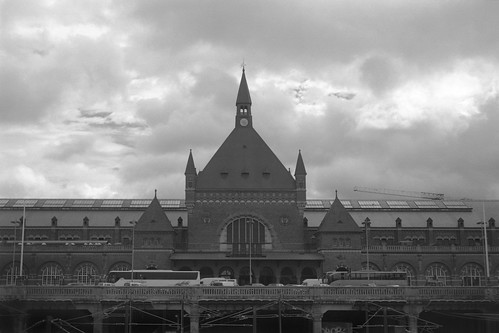
Forster specifically defines the stations termini although he generalises "a great capital", which in Howards End is Edwardian London. London's main railway stations are of course all termini, due to factors in the historical development of the city's infrastructure, mainly the size of London itself when the railways were introduced to the city, making it a less than practical endeavour to lay tracks directly through the capital from one side to the other, as well as the factor of the railways being built by competing private companies. This situation is only now being changed by Crossrail. Other capital cities suffered from the same infrastructural complexities, notably Paris, also very large by the middle of the nineteenth century, and, like London, has the same arrangement of terminal stations in a ring around the centre. St Petersburg, as a planned eighteenth century city is the same. In smaller cities however, some that I have recently travelled through by train, Brussels, Cologne, Hamburg and Copenhagen, the main railways stations are of the type where the trains run straight through: the terminal station has an implication that the capital or other city is a natural destination rather than just a stop (other than old capital cities, terminal stations are most frequently found on the coast). This may, in some small measure, account for one aspect of the capital-centric economy of the United Kingdom.


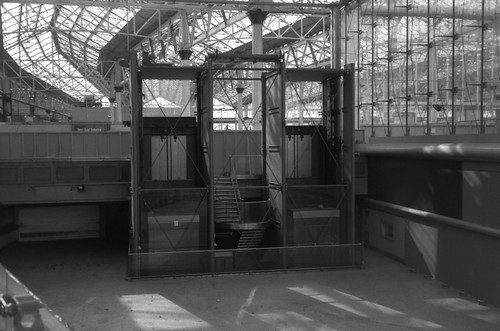
Rail travel was one of the nineteenth century technologies that fractured space, along with advances in image reproduction, identified by Patrick Keiller in his relating Henri Lefebvre's ideas to early cinema, and quoted in my post The Phantom Ride. The great railway stations in Europe were designed with the necessity of steam, with the result that the high spans of the train shed roofs often brought comparisons to cathedrals. As a result, these stations were not built with an economy of space, which has meant for contemporary use these generous spaces can be re-purposed, and frequently filled with kiosks and shops, often on more than one level, maximising the footprint of the buildings. When no longer a necessity, these railway termini are also beautifully adaptable, being re-used for cultural purposes such as the Musee d’Orsay in Paris and the Hamburger Bahnhof in Berlin. The former cathedrals of the nineteenth century's new connectivity have become cathedrals of culture. Recent attitudes towards station architecture show a new or, perhaps more accurately, a renewed pride: from the low point of the rebuilt Euston Station, designed to be like an airport for the period when air travel being glamorously within reach of larger parts of the population, hiding the messy business of the trains themselves, to Berlin's new Hauptbahnhof and the renovated Kings Cross and St Pancras in London as just two recent examples.
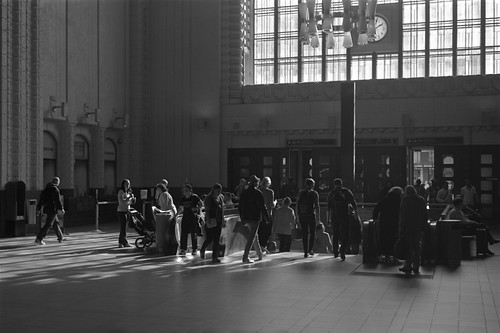

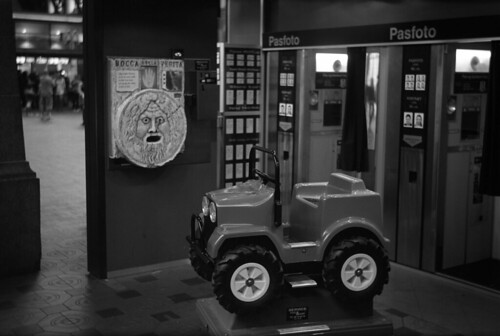
It is a truism to ascribe large, general similarities to airports around the world, a feature of post-war modernity, "subordinate pseudo-places" in Paul Fussell's words (tourist destinations are "pseudo-places" par excellence). By contrast, many large railway stations’ architecture is very particular, even vernacular, often from imperial periods in modern nation states' development, with stylistic reflections: Cologne’s steel arch with its glazed soaring lunettes either end (with neon names of brands associated with the city), Helsinki's distinct Baltic Style Moderne, Copenhagen’s double-vaulted wooden beamed roof, suggestive of an oversized medieval lodge. The Bocca Della Verita in Copenhagen Central that I had photographed in 2008 has gone from its position by the photo booths. I photographed the original in Rome four years earlier, the replica of it in Copenhagen was a fortune-telling machine for travellers to consult, oracle-like, before a journey.
Tuesday, 14 April 2015

Sketchbook

Moderna Museet, Stockholm 14/4/15


Monday, 13 April 2015

Ferries

"When you entered Manhatten by the Lincoln Tunnel twenty years ago [i.e. in 1960] you saw from the high west bank of the Hudson a vision that lifted your heart and in some measure redeemed the potholes and noise and lunacy and violence of the city. You saw the magic row of transatlantic liners nuzzling the island, their classy, frivolous red and black and white and green uttering their critique of the utility beige-gray of the buildings. In the row might be the Queen Mary or the Queen Elizabeth or the Mauretania, the United States or the America or the Independance, the Rafaello or the Michelangelo or the Liberté. These were the last attendants of the age of travel, soon to fall victim to the jet plane and the cost of oil and the cost of skilled labor."
Paul Fussell, Abroad
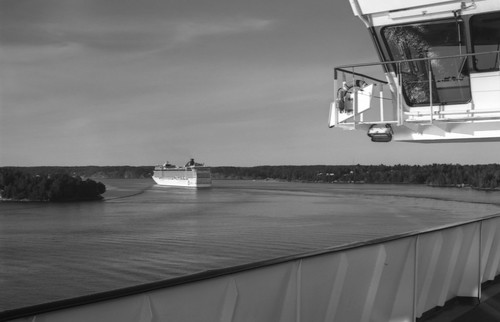
A number of years ago, I was commissioned to make some artwork for a cruise ship. A perk of this commission was that, many months later, when the ship docked in Southampton, the artists who had made work on board were invited to visit the ship while it was docked for the day. The ship was the size of a monstrous slab block of local authority housing, filling the terminal like a luxury hotel combined with a shopping centre. Inside, it gave the impression that it was anything but a sea going vessel, all the while insisting that this was in fact the case by being festooned with the symbols of maritime nature on almost every possible surface available for decoration. This also gave the ship's interior an appearance of, not so much opulence itself, but an idea of the opulence of sea-going travel, available, in reality, to relatively few people decades ago (there was certainly no steerage class on this ship, and travel by large ocean-going vessels is now very much a choice which reflects on those using it). The Baltic ferry from Stockholm to Helsinki taken on the route to St Petersburg felt very much a scaled down version of this, leading one to imagine that in the age of the "jet plane" and the budget airline, travel over the waves is largely an anti-utilitarian simulacra of that idea of a golden age that Paul Fussell was writing about.

Before the Channel Tunnel of course, the Channel ferry was the first glimpse of 'abroad' for those leaving England - or perhaps an interstitial space, neither home nor abroad. Unlike the huge cruise liner mentioned, or indeed the Baltic ferry, the Channel ferry never quite isolated its passengers from the reality of the means of transport. My earliest crossings to the Continent were by ferry, and, in the first instance, by hovercraft, like the telecommunications towers written about, a symbol of progressive technological advance now firmly stuck in the age when this was seen as symbolic of national pride - a future now gone. Although young, the main memory I have of the hovercraft was the aeroplane-style seating, the idea being that the crossing was to be so rapid that the passengers did not need to get up and move about for the duration. The hovercraft has been discontinued for many years. Later crossings were by more traditional ferry; when travelling to Paris by coach in 1994, I wrote that on the way there, we were not stopped at customs either at Dover or Calais, being waved, or waived, through on the coach itself. The return journey was not as pleasant: a customs official got on to the coach itself at Dover, and, after a student swore at her, we were all made to get off the coach and go through passport control individually. The coach driver, who had spent the duration of our stay in Paris drinking in the bar at the hotel, was rightly sarcastic about this as all the students got back on.


Taking the now-discontinued overnight ferry from Harwich to Esbjerg in Denmark some years ago, not knowing how easy it was to go through the boarding procedures, we got a train one hour earlier than needed, just in case, and as a result, had to wait in the tiny International terminal building in Harwich which has precious little facilities to speak of. There were very few foot passengers for the ferry, the security was simple, and one did not feel the weight of the state bearing down on the individual. Judging by the small amount of containers on board, the ferry did have some practical use in terms of imports and exports.

The resolution to Alice In The Cities occurs on a ferry across the Rhine. Having exhausted all leads in trying to find Alice's grandmother, after discovering that the house in Alice's photograph was now lived in by someone else, Philip decides to take Alice to his parents. At a kiosk beside the road, Philip finds a newspaper with a report in about Alice, but this is not acted upon. On the ferry across the Rhine, Alice asks Philip, "Are you looking forward to seeing your parents?" As the camera concentrates on the woman singing, accompanied by the boy who catches Alice's interest, sufficient to take a Polaroid photograph, we see the policeman that Philip and Alice had encountered in Wuppertal raising his sunglasses as he recognises them. He gets out of his car to approach Philip, saying that Alice's mother had been found. The few scenes that follow - Alice in the policeman's car, with Philip tailing them in his hired car; Alice giving Philip a hundred dollar bill "for your ticket"; and then the two of them on the train to Munich - are all a coda to this resolution of the quest to reunite Alice with her family, while still leaving the protagonists forever in movement, in the final shot of the two looking out of the train window as the aerial shot becomes ever higher and wider, seemingly in the camera's desire to encompass the whole of the Rhine valley.


Sunday, 12 April 2015

Picture Galleries

I was in Hamburg on a Monday. As seems a common convention in Northern European countries, the Hamburger Kunsthalle was closed. This may have been frustrating if I had the time to do anything other than get wet in my search for locations from The American Friend. On the trip from London to St Petersburg, we had 24 hours in Copenhagen - on a Monday. As a result, with culture shut for the day we went up the Round Tower, worth the small fee for the uniqueness of walking up a spiral ramp to the top, blessed with views all across the rooftops of the city - and, in the distance, the Oresund Bridge and the just visible outline of Sweden, the next day's journey by train. Returning from St Petersburg, we found ourselves in Helsinki on a Monday, with almost everything shut there.

Last week, in Copenhagen on a Wednesday, I went to the Statens Museum for Kunst. Enjoying their permanent collection (as well as an excellent temporary display on Durer's Triumphal Arch of Maxilimilian, shaming the British Museum's desultory display of the oversized print, for years badly lit next to the toilets), there was a realisation of the parochial qualities on institutions back in the UK which pretend otherwise: the National Gallery in London has very thin coverage of Northern European, specifically Scandinavian, painting. Of course, the National Gallery began as one man's collection, and represented the limitations one would expect; however, the idea that Italian painting, and specifically Italian Renaissance painting, was the pinnacle of the art persisted for many decades and perhaps is still informing acquisitions.

I arrived in Stockholm on this occasion in time for the Easter weekend. Certain things were shut, but some places ritually closed on a Monday were in fact open on Easter Monday - because this counted as Sunday for the purposes of opening times. However, the National Museum in Stockholm is currently undergoing major rebuilding work, so is closed (I did see the Denise Grunstein exhibition under the auspices of the National Museum at the Konstacademian; the most interesting of the photographs were those showing the backs of paintings from the National Museum, echoing the Cornelius Gijsbrechts painting in the Statens Museum in Copenhagen from the late seventeeth century of a back of a painting). I also visited the Thielska Galleriet. This is the house and collection of Ernest Thiel located at the far end of Djurgården. Most of the paintings, sculpture, drawings and prints were contemporary art from the decades immediately each side of 1900. Gifted to the state as a whole in 1924, it is the collection of one man, again, but the effect of the stasis of the collection as a capsule of taste is interesting: as well as those artists whose reputation has endured (Munch, Gaugin, Toulouse-Lautrec) or has increased (notably Vilhelm Hammershøi, represented by the large Five Portraits), it also includes artists whose reputations have dissipated since (I'm thinking of Anders Zorn, previously I've known Zorn from Lumsden's The Art of Etching; the collection having many etchings and some paintings, still popular in Sweden, but not more widely). Then there are the artists whose work remains largely unknown outside Scandinavian countries: Carl Larsson, Bruno Lilijfors, Gustav Fjaested, Karl Nordström, Esther Almqvist.

Two of the Karl Nordström charcoal drawings in the Thielska Galleriet concentrated on skies, taking up enough of the composition to be considered cloud studies; one of which featured just one large cloud. Having recently made a few paintings of clouds, as a means of making work free from many other concerns of subject matter that they felt as near to being just about painting itself as I can approach. Some of these paintings were based on photographs taken on the journey to St Petersburg; in the Hermitage, we saw a painting of a large cloud by Fyodor Vasilyev, which felt like a felicitous coincidence; the whole journey once leaving Copenhagen, through Sweden, the Baltic and Finland, was accompanied by bright and fine September weather. As well as the trompe l'oeil paintings by Gijsbrechts in the Statens Musuem For Kunst in Copenhagen this Spring, I also found some cloud paintings by  J. C. Dahl.

Saturday, 11 April 2015