I was in Hamburg on a Monday. As seems a common convention in Northern European countries, the Hamburger Kunsthalle was closed. This may have been frustrating if I had the time to do anything other than get wet in my search for locations from The American Friend. On the trip from London to St Petersburg, we had 24 hours in Copenhagen - on a Monday. As a result, with culture shut for the day we went up the Round Tower, worth the small fee for the uniqueness of walking up a spiral ramp to the top, blessed with views all across the rooftops of the city - and, in the distance, the Oresund Bridge and the just visible outline of Sweden, the next day's journey by train. Returning from St Petersburg, we found ourselves in Helsinki on a Monday, with almost everything shut there.
Last week, in Copenhagen on a Wednesday, I went to the Statens Museum for Kunst. Enjoying their permanent collection (as well as an excellent temporary display on Durer's Triumphal Arch of Maxilimilian, shaming the British Museum's desultory display of the oversized print, for years badly lit next to the toilets), there was a realisation of the parochial qualities on institutions back in the UK which pretend otherwise: the National Gallery in London has very thin coverage of Northern European, specifically Scandinavian, painting. Of course, the National Gallery began as one man's collection, and represented the limitations one would expect; however, the idea that Italian painting, and specifically Italian Renaissance painting, was the pinnacle of the art persisted for many decades and perhaps is still informing acquisitions.
I arrived in Stockholm on this occasion in time for the Easter weekend. Certain things were shut, but some places ritually closed on a Monday were in fact open on Easter Monday - because this counted as Sunday for the purposes of opening times. However, the National Museum in Stockholm is currently undergoing major rebuilding work, so is closed (I did see the Denise Grunstein exhibition under the auspices of the National Museum at the Konstacademian; the most interesting of the photographs were those showing the backs of paintings from the National Museum, echoing the Cornelius Gijsbrechts painting in the Statens Museum in Copenhagen from the late seventeeth century of a back of a painting). I also visited the Thielska Galleriet. This is the house and collection of Ernest Thiel located at the far end of Djurgården. Most of the paintings, sculpture, drawings and prints were contemporary art from the decades immediately each side of 1900. Gifted to the state as a whole in 1924, it is the collection of one man, again, but the effect of the stasis of the collection as a capsule of taste is interesting: as well as those artists whose reputation has endured (Munch, Gaugin, Toulouse-Lautrec) or has increased (notably Vilhelm Hammershøi, represented by the large Five Portraits), it also includes artists whose reputations have dissipated since (I'm thinking of Anders Zorn, previously I've known Zorn from Lumsden's The Art of Etching; the collection having many etchings and some paintings, still popular in Sweden, but not more widely). Then there are the artists whose work remains largely unknown outside Scandinavian countries: Carl Larsson, Bruno Lilijfors, Gustav Fjaested, Karl Nordström, Esther Almqvist.
Two of the Karl Nordström charcoal drawings in the Thielska Galleriet concentrated on skies, taking up enough of the composition to be considered cloud studies; one of which featured just one large cloud. Having recently made a few paintings of clouds, as a means of making work free from many other concerns of subject matter that they felt as near to being just about painting itself as I can approach. Some of these paintings were based on photographs taken on the journey to St Petersburg; in the Hermitage, we saw a painting of a large cloud by Fyodor Vasilyev, which felt like a felicitous coincidence; the whole journey once leaving Copenhagen, through Sweden, the Baltic and Finland, was accompanied by bright and fine September weather. As well as the trompe l'oeil paintings by Gijsbrechts in the Statens Musuem For Kunst in Copenhagen this Spring, I also found some cloud paintings by J. C. Dahl.
Sunday, 12 April 2015

Saturday, 11 April 2015


Friday, 10 April 2015
A View from A Room
As briefly described in the post Writing on Trains, while taking my short excursion through Germany and Denmark, I was able to keep writing this blog mostly during the course of the various train journeys. Now in Stockholm for over a week, being static there is no longer the same propulsion to write with the cascade of new impressions; instead, a different set of impressions is created, not through novelty but by repetitions of now familiar rhythms.
Staying at Telefonplan, in the southern suburbs, the regular rhythms are the trains of the T14 Tunnelbana line - Stockholm's light rail system. Due to the landscape that the city is built upon, these trains frequently move from above ground to underground (as the name suggests) and back again. Directly outside the two windows of the room I am in, immediately parallel to the road this building is on, the railway line comes out of a cutting from Telefonplan station, bounded by a rocky outcrop on one side, and pass over a bridge crossing a road, before going into a tunnel into the hill bounding the horizon. This hill, with some apartment buildings among bare trees and some evergreens on the ridge, is just conceivably reminiscent of an Italian landscape, firs or pines standing in for cypresses, of the kind Northern European artists were seeking out in the late 18th and early 19th century (such as Thomas Jones or C. W. Eckersberg). This is the scene that I've drawn on two of the postcards. At different times of day, the trains' frequency changes, and during busy morning and early evening periods, the regular T-bana trains are joined by older rolling stock, announced by a slightly higher pitched whine. These blue trains have a near-generic look of many European cities' light rail trains, such as classic Paris Metro trains, older Berlin (or Hamburg) U-bahn trains - boxy, unstreamlined, with ridged metal panels, rounded corners to the narrow windows on the doors, individual seats, bare metal pillars and handles.
Although there was snow on the first morning after my arrival, the weather has turned fine since and the passing of the day is figured by the changing direction of the sun harshly back-lighting the scene during the height of the day, throwing the rocks and concrete of the embankment into sharp relief during the evenings with a parallel direction to the road and railway. A series of flags outside provide a regular snapping sound of ropes against poles in the wind.
The architecture at Telefonplan has an unadorned utility that is hard to date: large tall blocks of many floors with regular grids of windows, the brutal bare concrete tower that dominates the local skyline. Small details betray something of their age: the extensive use of terrazzo, for window sills as well as stairs, the small amount of wood in a few areas, and the tapered pillars outside. In the Spårvägsmuseet, Stockholm's transport museum, there was a display of photographs by Sven Goliath (1918-1989), which included a shot of Telefonplan from 1954, clearly showing the concrete tower and existing buildings very much as they are today. The whole complex which now includes offices, the art school, and accommodation and other services used to be the headquarters of Ericsson, and a bust of L. M. Ericsson stands on the corner diagonally opposite the station, next to one of the curious public telephones of the Rikstelefon with its odd flared lattice base. The main factory and office buildings were designed by Ture Wennerholm and built 1938-40; the 70 metre high tower was added after the Second World War, and designed by C. Dahl Steffensen. The tower is referred on the Swedish Wikipedia page about the Ericsson factory at Telefonplan to by the compound word kortvågsforskning, which translates as 'short-wave research' - this must be for microwave transmissions, the impetus behind the Kaknästornet written about under 'Panoramania'. The tower is not open to the public; however, opening a door at the end of a corridor on the top floor - the seventh floor - of the accommodation block, led into the adjoining building, into a stairwell that went as high as the 13th floor, halfway up the height of the Telefonplan tower opposite.

Staying at Telefonplan, in the southern suburbs, the regular rhythms are the trains of the T14 Tunnelbana line - Stockholm's light rail system. Due to the landscape that the city is built upon, these trains frequently move from above ground to underground (as the name suggests) and back again. Directly outside the two windows of the room I am in, immediately parallel to the road this building is on, the railway line comes out of a cutting from Telefonplan station, bounded by a rocky outcrop on one side, and pass over a bridge crossing a road, before going into a tunnel into the hill bounding the horizon. This hill, with some apartment buildings among bare trees and some evergreens on the ridge, is just conceivably reminiscent of an Italian landscape, firs or pines standing in for cypresses, of the kind Northern European artists were seeking out in the late 18th and early 19th century (such as Thomas Jones or C. W. Eckersberg). This is the scene that I've drawn on two of the postcards. At different times of day, the trains' frequency changes, and during busy morning and early evening periods, the regular T-bana trains are joined by older rolling stock, announced by a slightly higher pitched whine. These blue trains have a near-generic look of many European cities' light rail trains, such as classic Paris Metro trains, older Berlin (or Hamburg) U-bahn trains - boxy, unstreamlined, with ridged metal panels, rounded corners to the narrow windows on the doors, individual seats, bare metal pillars and handles.
Although there was snow on the first morning after my arrival, the weather has turned fine since and the passing of the day is figured by the changing direction of the sun harshly back-lighting the scene during the height of the day, throwing the rocks and concrete of the embankment into sharp relief during the evenings with a parallel direction to the road and railway. A series of flags outside provide a regular snapping sound of ropes against poles in the wind.
The architecture at Telefonplan has an unadorned utility that is hard to date: large tall blocks of many floors with regular grids of windows, the brutal bare concrete tower that dominates the local skyline. Small details betray something of their age: the extensive use of terrazzo, for window sills as well as stairs, the small amount of wood in a few areas, and the tapered pillars outside. In the Spårvägsmuseet, Stockholm's transport museum, there was a display of photographs by Sven Goliath (1918-1989), which included a shot of Telefonplan from 1954, clearly showing the concrete tower and existing buildings very much as they are today. The whole complex which now includes offices, the art school, and accommodation and other services used to be the headquarters of Ericsson, and a bust of L. M. Ericsson stands on the corner diagonally opposite the station, next to one of the curious public telephones of the Rikstelefon with its odd flared lattice base. The main factory and office buildings were designed by Ture Wennerholm and built 1938-40; the 70 metre high tower was added after the Second World War, and designed by C. Dahl Steffensen. The tower is referred on the Swedish Wikipedia page about the Ericsson factory at Telefonplan to by the compound word kortvågsforskning, which translates as 'short-wave research' - this must be for microwave transmissions, the impetus behind the Kaknästornet written about under 'Panoramania'. The tower is not open to the public; however, opening a door at the end of a corridor on the top floor - the seventh floor - of the accommodation block, led into the adjoining building, into a stairwell that went as high as the 13th floor, halfway up the height of the Telefonplan tower opposite.
Thursday, 9 April 2015
Flea markets
Since being in Stockholm I have been to two of the local flea markets: the Sunday market at Hötorget, and the all-week around market, Loppmarknaden at Vårberg. The overall quality of the stalls at Hötorget was better, but the prices were much higher, and as a consequence, although I saw a number of items of interest, all were too expensive. At Loppmarknaden, which is an underground hall in the shopping complex attached to Vårberg station, some of the stalls were little more than just piles of household rubbish, and presented as such. The market charges an entry fee at weekends, but I went on a weekday. It's possible that it may be busier, and with more stalls at the weekend. There was a good deal of furniture and furnishings from the 1950s-60s-70s, which holds onto a use value for longer than items generally thought of as technology, where the turnover is more rapid: VHS players, portable CRT televisions, sterograms, many early digital cameras, game consoles and games, and whole boxes of remote controls and chargers.
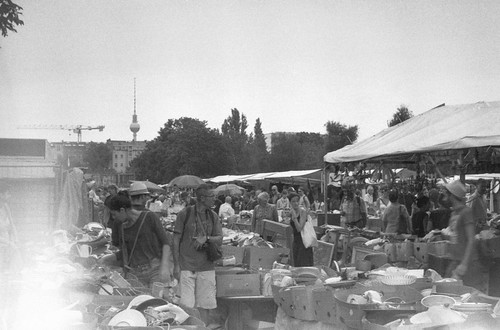
The flea market neatly brings together the flaneur and the objet trouvé. London is poor in this regard, perhaps due to knowing the price of everything. In the UK, the car boot sale is the nearest native equivalent, yet the car boot sale rarely produces the same feelings of felicity and serendipity. Possibly at one time, the wares for sale could have said something specific about the society in which they are found (but these flea markets are becoming more universalised across different countries, which in itself suggests homogenisation) - by what society can't quite bring itself to throw away and eke some last monetary value from. One feels that some of this junk simply circulates.
As usual, I was interested in cameras, photographic equipment and related items. There were many digital cameras from about a decade ago, a number of older SLRs, but the only camera that caught my eye, was an Agfa Isolette III. This looked in good condition, although a bit dusty, and everything worked except for the uncoupled rangefinder, which was stuck, and I may be able to repair this, but what piqued my interest sufficiently to buy it was the half-used roll of film inside. The seller wanted (and got) 200 SEK, just over £15. A few years ago I bought a Werra camera from the Mauerpark Flohmarkt in Berlin (the best flea market I have been to), which had a roll of half-used film inside. Despite opening the back and exposing the film, I was able to shoot the remaining film to get some images of the flea market on the camera I had just bought, and recover the undeveloped images, dormant for many years before the camera passed into my hands. Similarly, I finished the roll of film in the Isolette at Vårberg.

The flea market neatly brings together the flaneur and the objet trouvé. London is poor in this regard, perhaps due to knowing the price of everything. In the UK, the car boot sale is the nearest native equivalent, yet the car boot sale rarely produces the same feelings of felicity and serendipity. Possibly at one time, the wares for sale could have said something specific about the society in which they are found (but these flea markets are becoming more universalised across different countries, which in itself suggests homogenisation) - by what society can't quite bring itself to throw away and eke some last monetary value from. One feels that some of this junk simply circulates.
As usual, I was interested in cameras, photographic equipment and related items. There were many digital cameras from about a decade ago, a number of older SLRs, but the only camera that caught my eye, was an Agfa Isolette III. This looked in good condition, although a bit dusty, and everything worked except for the uncoupled rangefinder, which was stuck, and I may be able to repair this, but what piqued my interest sufficiently to buy it was the half-used roll of film inside. The seller wanted (and got) 200 SEK, just over £15. A few years ago I bought a Werra camera from the Mauerpark Flohmarkt in Berlin (the best flea market I have been to), which had a roll of half-used film inside. Despite opening the back and exposing the film, I was able to shoot the remaining film to get some images of the flea market on the camera I had just bought, and recover the undeveloped images, dormant for many years before the camera passed into my hands. Similarly, I finished the roll of film in the Isolette at Vårberg.
Wednesday, 8 April 2015
The Reisekamera
“Young Smith, the Secretary of our Photographic Club, called at nine to ask me to take him a negative of the statue of the dying Gladiator in the Munich Sculpture Gallery. I told him that I should be delighted to oblige him, but that I did not intend to take my camera with me. “Not take your camera!” he said. “You are going to Germany—to Rhineland! You are going to pass through some of the most picturesque scenery, and stay at some of the most ancient and famous towns of Europe, and are going to leave your photographic apparatus behind you, and you call yourself an artist!” He said I should never regret a thing more in my life than going without that camera.”Photography has been intrinsically linked to travel since its very beginnings. The camera itself, before the invention of photography, was already in use as a travelling companion for artists and amateurs, cameras obscura being manufactured in portable versions, and the camera lucida appearing in 1807. An early amateur user of the camera lucida, William Henry Fox Talbot was frustrated with his lack of skill in drawing when attempting to make pictures at Lake Como in 1833. This European travel was a resumption of the idea of the aristocratic Grand Tour, made bourgeois, a benefit of the peace that followed the Congress of Vienna. Famously, he desired that the scene to be able to draw itself:
Diary of a Pilgrimage, Jerome K. Jerome
"...the idea occurred to me... how charming it would be if it were possible to cause these natural images to imprint themselves durably, and remained fixed upon the paper!"Interestingly, he also used a camera obscura, with waxed paper to trace the utlines of an image upon; this works very differently from the camera lucida, which does not project the image, and the former device leads more directly to the invention of photography. Concurrently, in France, Niépce had made his own experiments, but conceived of photography primarily as a medium to reproduce existing works of art; Daguerre, who took up Niépce's work, had previously invented the diorama, a spectacular form of entertainment, noted for its changing lighting effects, that competed with the panorama - and, like the panorama, was capable of bringing distant lands to a sophisticated urban audience.
William Henry Fox Talbot, The Pencil of Nature
Despite all the technological difficulties of a truly mobile photography, from the beginnings of the wet plate photograph, the camera travelled - alongside a mobile darkroom. Glass plates had to be coated with a light-sensitive emulsion, and then exposed in the camera while this emulsion was still wet and subsequently developed. Photographic expeditions in the 19th century were very much in the mould of imperial explorations, with mule trains, handlers, camp equipment and such like, up to the point of the formulation of the dry plate. These could be bought from specialist manufacturers in bulk, exposed in the camera, then developed at leisure when the photographer returned. Shortly afterwards, towards the close of the 19th century, the Kodak camera was produced, and, together with flexible roll film, defined photography for much of the century to come. A symbol of the affinity between travel and photography was the fact that many cameras were named with such associations: the Reisekamera - literally "travel-camera" - was an early, more mobile version of a studio plate camera. This idea became more prevalent as photography became increasingly available to the widest sections of society. There are at least five different cameras that use the word tourist in their names; four different traveler cameras (and one traveller); a couple of explorers; the Russian Sputnik camera may have been named for the satellite, but 'sputnik' can be literally translated as "travelling companion"; and a great number of 'scout', usually box, cameras, with all the implications of camping and the outdoors.
The first time I used a camera, that I was given a camera to use - I presume I must have shown an interest in doing so - was in 1983, on holiday, camping in France. These very first photographs were taken with a Kodak Instamatic 50, making square photographs using the old 126 cartridge format (my mother had just been given a new 35mm SLR camera, and indeed, I'd forgotten about these early photographs for many years).
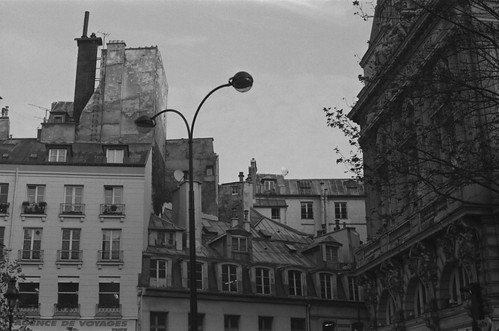
In Paris in 1994, with my then nearly new (to me) secondhand Praktica SLR, I shot five rolls of film, all black and white, the first negatives that I developed in the darkroom at my college on my degree. Looking back at the contact sheets, the images are (mostly) of subjects I would not now take photographs of - both the subjects, or their framings, specifically. There are lots of photographs of statuary, perhaps not surprising for my first experience of Paris. Notably, I went to the Louvre and didn't go to see any paintings at all, just sculpture. The sculpture stood in for missing human subjects, and the images ended up being used in photo-collages and etchings, including a series of photo-collages made at home over the Christmas break. I was also interested in the medium of the artist book at the time, which I made from original photographs, photocopies, and ephemeral material collected from the journey. However, these became exercises in empty aestheticism: I was looking to create complicated imagery that suggested meaning, without containing it. It was a lack of confidence that I could not let the photographs exist on their own merits.
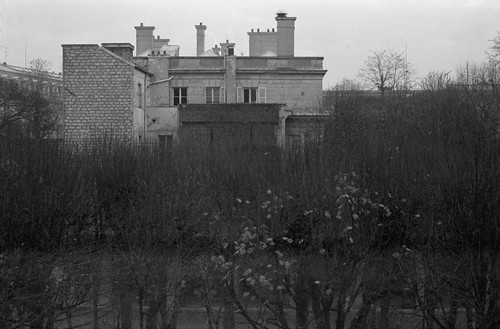
In the years since I have always travelled with a camera. This in itself is not remarkable, especially now that almost everyone has some form of camera as part of a modern communication device. In Abroad, Paul Fussell uses the absence of photography as a distinguishing characteristic:
"...it is hard to be a snob and a tourist at the same time. A way to combine both roles is to become an anti-tourist. Despite the suffering he undergoes, the anti-tourist is not to be confused with the traveler [Fussell makes distinctions between explorers, travellers, and tourists]: his motive is not inquiry but self protection and vanity. [...] A useful trick is ostentatiously not carrying a camera. If asked about this deficiency by a camera-carrying tourist, one scores points by saying, "I never carry a camera. If I photograph things I don't really see them."It is too simplistic to reduce experiences of looking in combination with photographing to the binary oppositions of the anti-tourist. For a time, perversely, I took a number of trips accompanied only by an old 35mm stereo camera. The severe limitations of using this format made sense for a time, but the camera wasn't very reliable. On more recent journeys I've taken a 35mm camera, a folding medium format camera, and some form of subminiature camera too.

Using film does mean not being able to see one's results immediately, usually not until after returning home. The photograph's function as an aide memoire is reinforced in the process of developing and revisiting images which may have been present in the viewfinder for a fraction of a second. Polaroids of course share a near-instantaneous aspect with digital photography: in Wim Wenders Alice In The Cities, Philip uses a Polaroid camera to photograph the surfaces of America, specifically the innovative SX-70, then relatively new, using integral film (not peel-apart negatives and positives which previous instant cameras used); Dennis Hopper in The American Friend photographs himself with a Polaroid. Leaving the development of film until later always provides an anxiety, however small, that something may go wrong with the film. Thus the undeveloped film is a precious cargo, a repository of memories and locations. On my journey through Brussels, Cologne, Wuppertal, Gelsenkirchen, Hamburg, Copenhagen and Stockholm, I've shot a number of rolls of film in all three formats. Their contents will reveal themselves in the course of time.

Subscribe to:
Posts (Atom)