Thursday, 2 April 2015

Border Crossings

"Indeed, nothing makes us more sensible of the immense relapse into which the world fell after the First World War than the restrictions on man's freedom of movement and the diminution of his civil rights. Before 1914 the earth had belonged to all. People went where they wished and stayed as long as they pleased. There were no permits, no visas, and it always gives me pleasure to astonish the young by telling them that before 1914 I traveled from Europe to India and to America without passport and without ever having seen one."
Stefan Zweig, The World of Yesterday, 1942

"Today I'm so old that I'm almost blind. When I first opened my eyes to the light, in 1915, all the countries of Europe were busy slaughtering each other. And each of those countries felt justice was on its side. […] Now that my eyes have almost completely dimmed, I see, by that last light, that the countries of Europe are embracing each other and forgetting their borders. That whole turnaround took place within the space of my almost ninety years. I still find that unbelievable. But I also know how difficult it has been."
Vittorio Foa, quoted in In Europe: Travels through the twentieth century, Geert Mak, 2004
Having travelled from London to Brussels, to Cologne, through Germany to Denmark and finally Sweden these past few days, I needed only to show my passport to leave London. A year and a half ago, travelling to St Petersburg, the passport and a visa were required to enter Russia, which we did by train from Helsinki. All countries in between are now part of the Schengen Area, where internal border controls have disappeared; a consequence of this disappearance is the relative strengthening of external borders. Our bags were x-rayed leaving Russia, but not when boarding the train at Helsinki Central station. Crossing the border separating Finland and Russia by train occurs between the towns of Vainikkala and Vyborg. Customs and passport officials from both countries get on the train and examine the passengers' travel documents at their seats, while the train moves - slowly - from one stop to the next in the 'customs surveillance zone'. A man with a Norwegian passport at our table pronounced it "very John Le Carré", though in truth it was a relatively simple set of checks, and no bags were opened (leaving Russia I was asked how much Russian currency I had; bags were only opened at the controls when getting back onto the Eurostar at Brussels). The border itself appears to be a no-man's land in the birch forest: the trees are cleared along the line of the border, there are wire fences running alongside the track itself, and there was a guard with an automatic weapon standing by his vehicle on a dirt track.


However, as a citizen of the United Kingdom, a passport is still necessary in the Schengen Area thanks to the UK's opt out of the agreement, and the lack of identity cards: when visiting the Moderna Museet in the three hours between the ferry from Helsinki and the train to Copenhagen, not wanting to change any currency to Swedish Kronor, we did not have change for the lockers. Asking at the desk, I was told that they would provide a 5-kronor coin for the lockers on security of my ID card: there was a moment's perplexity when I handed over my passport instead. Despite Stefan Zweig's assertions above, about travel before the First World War, passports were still of use, if not strictly necessary, in the same fashion as they are today when the holder does not have an identity card:
“In Northern Germany, as well as in France, Belgium, and Holland, passports are unnecessary. Those, however, who contemplate an extension of their tour to the Austrian dominions cannot cross the frontier without one of these documents, which must moreover have the visa of the Austrian ambassador at London, or other European capital. It should also be borne in mind that a passport may frequently be necessary to prove the identity of the traveller, procure admission to collections, obtain delivery of registered letters etc., in countries where the possession of such credentials is in other respects unnecessary.”
The Rhine and Northern Germany, Karl Baedeker, 1870

Nevertheless, as a UK national outside of the Schengen Area, travel by the Eurostar - and by ferry - is still less of an ordeal than travelling by plane. When boarding, there is none of the sense of entering a zone of exception that one gets at airports, although the security is still stringent; travelling to Denmark on the now discontinued Harwich-Esbjerg ferry, leaving the UK and entering the Schengen Area was even easier - there was no requirement to be there half an hour before boarding such as there is with the Eurostar, and the London to Harwich train used to arrive just minutes before the ferry sailed. This last fact felt not to be trusted at the time: however, taking the previous scheduled train - a whole hour earlier - there was then precious little to do in the tiny ferry terminal, quite unlike a modern airport, where all the enforced waiting time seems primarily to be diverted to consumption.

The opening of Wim Wenders' Lisbon Story, from 1994 is a condensed road movie in itself, travelling from Dusseldorf in Germany, to Lisbon, Portugal, a celebration of the new Europe of the Schengen Agreement. Lisbon Story begins with a montage of a postcard from the title city arriving, then becoming buried amongst a subsequent accumulation of post (including a newspaper with a byline ‘Ciao Federico’ announcing the death of Fellini - which echoes the end of Alice In The Cities, where a newspaper Philip is reading announces the death of the director John Ford; incidentally Lisbon Story has a cameo role for Manoel de Oliveira, the Portuguese film director who began his career in the silent era and whose death has just been announced). The post is addressed to 'Philip Winter', and the postcard is retrieved from the pile, by a hand, all that is seen of Philip at this point. The postcard is turned so that the viewer can read it:
“Mensch! Winter! I need your help! I cannot continue. M.O.S.! S.O.S.! Come to Lisbon with all your stuff A.S.A.P. Big hug, Fritz” [A stamp on the card reads:] “No Fon/No Fax/Write"
As this is read out, as a voice-over, the scene then shifts to a view through the windscreen of a moving car - the phantom ride again. As the credits appear, the voice-over combines with a radio soundtrack of various snatches of music and speech, in a series of quick, hard cuts all with the same view framed by the windscreen as the car travels from Germany to Paris, and then through France to Spain. The weather changes, and the monotony of  motorway driving is broken up by a couple of views from the car, apparently arriving at a hotel, then cutting to its onward journey. The audio montage of radio and music acts as an overture: there are snippets of the group Madredeus, who will feature later in the film, but as well as looking forwards, this rapid switching of music also looks back to Wim Wenders' road movies of the 1970s, as it features the German group Can, who provided the music for Alice In The Cities. What begins apparently as a stream of consciousness voice-over, is revealed, as it continues, as a spoken monologue by Philip to himself as he drives:
Europe has no borders.
The barriers have been lifted and anyone can cross over.
Can't I show my passport to anyone?
Please, let me open the boot!
You're not going to believe what I've got in here!
Testing, one, two, three, one, two.
I haven't travelled such a long distance by car in a long time.
I realise that Europe is becoming a single nation...
The languages change, the music changes, the news is different, but...
The landscape speaks the same language
and tells stories of an old continent filled with war and peace.
It's nice to drive without thinking about anything,
passing here and there through stories and the ghost of history.
Here, I feel at home.
This is my homeland! [The voiceover has been in German up to this point; this last sentence is repeated in French, Spanish, English, Portuguese. The voiceover continues by repeating the phrases in Portuguese from a tape.]
I'm looking for a book to study Portuguese.
What kind of book?
Big or small?
Small. [Here we see Philip Winter for the first time, five minutes into the film, driving the car in a reverse angle shot through the windscreen.]
But you already speak Portuguese.
I don't speak well, I'm a foreigner.
Are you English?
No, I'm French...
[Philip says:] No, I'm German.
But I live in Portugal.
Lesson No. 1.
I'll never learn this...
[A sign with 'Portugal 40km' is seen in long shot from outside the car.]
Again.
Lesson No.1. In the bookshop.
Good morning.
The tape continues after Philip gets a flat tyre, and once the car pulls in to the side of the road, when he gets out, we see for that he has a leg in a cast and is using a crutch. This helps to provide something of a slapstick tone, when Philip knocks the spare tyre, which he had just placed on the parapet of the bridge where he has stopped, into the river below. Having repaired the flat tyre, he arrives at partly demolished customs building on the Portuguese border with his engine overheating. There is no one around: the building is empty and the phone does not work. Philip flags down a coach, waving his crutch in the middle of the road, and we see him topping up the car's radiator with bottles of soft drink. The car soon breaks down once more, and we then see Philip on the back of a donkey cart with piles of his belongings, including the license plate, 'F-PW-94'.

Brussels to Cologne

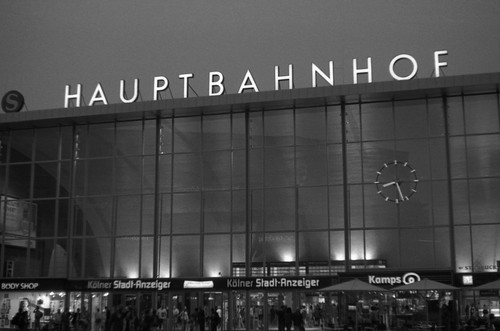
The last time I was in Cologne, it was for less than an hour to change trains, boarding the City Night Line sleeper service to Copenhagen. On Saturday, I had most of the afternoon. With a few hours to spare before catching the train to Wuppertal, one thing I wanted to seek out in Cologne was Ernst Barlach's Der Schwebende. A literal translation is 'The Hovering' (as the Schwebebahn in Wuppertal is the hovering or floating train) but it's generally known as the Hovering Angel or simply Barlach's Angel; I had seen the Güstrow version of this sculpture in the recent British Museum exhibition Germany: Memories of a Nation. In Neil MacGregor's book to accompany the exhibition he details the remarkable survival of the Hovering Angel. Barlach's work was included in the Entartete Kunst exhibition and the original sculpture was destroyed. However, a cast had been hidden, but at the end of the war it could not be returned to Güstrow Cathedral, now in what would become East Germany. The surviving bronze cast was installed in the Antonite Church in Cologne. As a sign of cross-border friendship a new cast was made from the second Hovering Angel to be placed back in Güstrow Cathedral. This was the sculpture displayed in the British Museum. Barlach's experiences in the First World War made him a pacifist, but Der Schwebende is ambiguous as a memorial in terms of a position on the war itself, Barlach intended it to be approached by the viewer with "recollection and inner reflection". It represents muted grief with the features, appropriately, of Käthe Kollwitz, who lost a son at the start of the conflict. This lack of positioning made the sculpture suspect for the Nazis, beyond stylistic considerations: totalitarian regimes cannot stand ambiguity, as it allows for open interpretations. In Güstrow, the sculpture is suspended above the old font; in the Antonite Church Der Schwebende hangs above a slab which simply reads: 1914 - 1918/1933 - 1945.


Wednesday, 1 April 2015

Erasures

"A map is the most exciting thing in the world for me; when I see a map, I immediately feel restless, especially when it's of a country or a city where I've never been. I look at all the names and I want to know the things they refer to, the cities of a country, the streets of a city. When I look at a map, it turns into an allegory for the whole of life. The only thing that makes it bearable is to try to mark out a route, and follow it through the city or country. Stories do just that: they become your roads in a strange land, where but for them, you might go to thousands of places without ever arriving anywhere."
 'Impossible Stories', Wim Wenders, in The Logic of Images
In The American Friend, some shots of Jonathan Zimmerman's framing workshop show it to have a street sign on the wall above the placard "Gemülde/Rahmen". This can just be read as 'Kleiner Pinnas'. An online search found no street by this name in Hamburg. However, other shots in the film show the strreet which this joins, with the name 'Lange Strasse'. One feature of my research before leaving London was the availability of viewing maps online - and in some cases, using Google Street View when available, which it was in Wuppertal, but not Gelsenkirchen. On Google Maps, Lange Strasse is shown running parallel to a street named Pinnasberg, before turning to join it. There is an unnamed path - in grey - connecting the two before this turning. On Open Street Map this is shown as a footpath that cuts behind the houses from Lange Strasse to Pinnasberg. The street name where the framing workshop is clearly a diminutive derivative of Pinnasberg.

This part of Hamburg, St Pauli, has been transformed in the years since the film. The whole riverside and dock area has been subject to massive investment, and between St Pauli and the old centre of Hamburg is the huge Hafencity development, where islands of old warehouses have been replaced by modern offices and a new concert hall. Some of this investment has been spread along the dockside to St Pauli. In the film, shots of  the Zimmermans' apartment, and the shop, show large areas of open, undeveloped land, often functioning as car parks. There is some preparation of the foundations for a block in Lange Strasse, a detail in the background, showing the beginning of the process of filling in these gaps. Arriving in St Pauli, the building used in the film for the apartment is easy to find, on the bend of St Pauli Fischmarkt, despite being blocked on Street View (something I have found to be common in my searches for the various locations in German cities). However, the blurred panels appeared to be the right shape and size, and the satellite imagery looked as though, from the roof, it might be the same building, which it was. Since the film, all the vacant plots around the apartment building have been filled with new blocks, and there has been a new dock wall built separating the road from the dockside; in the film, the ground in front of the apartment leads uninterrupted onto the dockside.This wall has presumably been built for flood defence purposes, and there are road signs referring to flooding in the area. The road in front of the apartment is far busier than it is shown in the film. The buildings opposite the apartment with the graffiti are gone, and the view from the Zimmermans' apartment no longer has the sense of open space as it is shown to have in the film.


Shots of Kleiner Pinnas in the film show it sloping away from the dockside, a straight perspective view used to good effect when lit from behind with the low winter sun shining on the cobbles. Finding Lange Strasse located just a couple of blocks behind St Pauli Fischmarkt (in the film there is no sense how close these are), I discovered why Kleiner Pinnas has disappeared from the map. As best shown on Open Street Map, where once this small road connected Pinnasberg and Lange Strasse, the space behind this two rows of apartment blocks is now a communal garden with a footpath, not straight, but with a serpentine route from street to street and the incline has been changed, steeper at one end, more level in the middle, behind the houses. There is a children's play area and what appear to be mature trees, though these must be less than forty years old, making it a little difficult to picture it as it looks in the film. At the Lange Strasse end, there is a sunken garage and its ramp fills most of the width of where the street once was, with the footpath running up one side. However, although the street sign for Kleiner Pinnas has gone, and with it an erasing of the identity of this small thoroughfare, the building it was on, Jonathan's framing shop, is still there. It is now a beauty parlour of some kind.


After Jonathan's apartment and workshop, the other Hamburg locations of The American Friend are all easy to find, both in virtual terms and in Hamburg itself. The St Pauli Elbtunnel which Johnathan runs through to and from his doctor still functions as a crossing for the Elbe. I descended into it after six in the evening when the lifts which take the cars from street level to the tunnel stop running. The Dom funfair, shown in a brief scene, takes place at Christmas and Easter; it was just opening when I arrived - the lights of the distinctive sign above the gate came on while I was taking photographs. What doesn't show in the film, as the scene takes place after dark, is the giant bulk of the Heiligengeistfeld Flakturm, which dominates views of the funfair.


Finally, I took a long walk to see Ripley's villa on Elbchauseestrasse. From the balcony above the portico, this has commanding views over the Elbe, back towards the docks. This, the Säulenvilla, is in itself considered something of a local landmark, having an entry - and picture - on one of the information panels that feature around Hamburg. The description reads:
1817 von dem Baumeister Axel Bundsen fur den Hamburger-Russland-Kauffman und Reeder Wilhelm Brandt erichtes Landhaus, einer Villa auf der Krim nachempfunden.
The American Friend isn't mentioned.


Graffiti in The American Friend

Before the the opening credits of The American Friend are complete, the scene shifts from New York to Hamburg. “Ein film von Wim Wenders” appears on screen, superimposed on a shot of a building that is later revealed to be Jonathan Zimmerman’s apartment. This is surrounded by waste ground, with remnants of snow, and, too small to be clearly read in this scene, there is graffiti on the wall of an adjacent building. This graffiti is revealed in a shot much later in the film when Jonathan returns from committing a murder in Paris. It reads: “BRD=Polizeistaat!”.

In 'Impossible Stories' (1982), Wim Wenders describes his work of the 1970s into the early 80s as consisting of 'A-films' and 'B-films':
"In the first group (A) all the films are in black and white [...] In the other group (B) all the films are in colour, and they are based on published novels. The films in group A, on the other hand, are based without exception on ideas of mine - the word 'idea' is used very loosely to refer to dreams, daydreams and experiences of all kinds."
Wim Wenders, 'Impossible Stories', in The Logic of Images
Wenders states that, during this period, each film was a reaction against the previous film he had made: The American Friend is one such B-film, made after Im Lauf Den Zeit (a literal translation is "In the Course of Time"; it was released under the English title, Kings of the Road), the last film in the 'road movies trilogy' which began with Alice In The Cities, itself a reaction against Wenders' unhappy experiences with The Scarlet Letter. The American Friend was in fact based on an unpublished novel, Patricia Highsmith's Ripley's Game: Wenders had wanted to use source material from Highsmith, but the rights of all her published work had been already sold at the time. In adapting the material, Wenders shifted much the important action from France to Hamburg in Germany.

The locations in Hamburg around Jonathan's home and framing workshop show a city of empty spaces and isolated apartment blocks facing the Elbe and the docks opposite. A reasonable assumption to make is that this townscape is the result of bombing in the Second World War, not yet rebuilt, thirty years after the destruction. In another scene, as the Zimmermans drive away from the apartment building in their orange Volkswagen, we can see another slogan, on a building behind the first: “Mord an Holger Meins/Nieder mit der Klassenjustiz/Rote Hilfe”. A rough translation would be: “Holger Meins was murdered/Down with [bourgeois] class justice!/Red Aid”. Filmed at the end of 1976, The American Friend is contemporary with the long Stammheim trial of Andreas Baader, Gudrun Ensslin, Ulrik Meinhof and Jan Carl Raspe, original members of the Rote Armee Fraktion, otherwise known as the Baader-Meinhof Gang; Holger Meins had died on hunger strike two years earlier. The 'Rote Hilfe' referred to is a left-wing support group that worked for the RAF prisoners, inspired by a Communist organisation of the same name from Weimar-era Germany. The presence of the graffiti adds to the film’s sense of moral decay as Jonathan acquiesces to the manipulations of Raoul and, unknowingly, Ripley. That Jonathan is seen walking past the first slogan “BRD=Polizeistaat!” (which translates as “BRD" - the Bundesrepublik or West Germany "=Police state”) when he returns from the murder in Paris feels like commentary: state murder and individual murder are equated in a sense of the cheapness of life, heightened by Jonathan's existential crisis. Raoul attempts to assuage Jonathan's conscience by calling the people to be murdered 'bad' men in simplistic terms. Such simplicity does bring to mind an abitrariness: Raoul and his associates have designated them 'bad men', and for that they need to die.


These slogans on the walls of Hamburg are presumably genuine: I have already written about Wenders' fidelity to his locations; but they are also deliberately included. Perhaps they are shown to be indicative of the area in which Jonathan and his family live, in the St Pauli district, just a short distance from the infamous Reeperbahn (in one early exchange, one of the first things that Jonathan says to Ripley, in English, is, "The Reeperbahn is not what it used to be", and one can hear the quotation marks as Jonathan says this). Hamburg in the film, despite being shown as a working port, appears in material terms to be depressed economically. Capital flows through the docks, barely adhering to the town itself. The post-war West German economic miracle has left it alone, or incomplete; meanwhile, this economic miracle appears to have been bought, in part, with a willing amnesia by large sections of German society in order to build a new state. This was one motivating factor for the Baader-Meinhof Gang's violent puncturing of this complacent West German prosperity, a prosperity that had to deal with the oil shocks of the 1970s by the time of The American Friend. Growing unease with the state's closeness to America at the time of the Vietnam war, and the presence of US army bases in Germany helped create the conditions for extreme left-wing reaction. Wim Wenders would not have been unaware of this:
"As part of the '68 generation, Wenders was drawn into politics at this time, at one time being arrested and charged for resisting arrest at a demonstration. However, although he was active in protesting against the Vietnam War, he was not able to shake his ambivalence towards America. He continued to attend screenings of his beloved Westerns every evening and thus never quite fitted into the anti-imperialistic milieu of his student sharehouse."
David Tacon, Great Directors: Wim Wenders
In many of his films, America and American culture feature far more prominently than those films of his contemporaries (notably Herzog and Fassbinder). This American culture fills a void left by the necessary idea, if not the actuality, of starting a new state from scratch after the war. It also fills a role similar to the absent fathers that recur in Wim Wenders' films. In Kings Of The Road, this is famously summed up as, "The Americans have colonised our subconscious". Wenders has always felt this as both a pull and a push, ambivalence and criticality side by side with a love for the surfaces of such a culture. In The American Friend this relationship is symbolically mirrored in the friendship - cautious, amoral, yet genuine and galvanising - that develops between the two men.

The graffiti in The American Friend is doubly echoed in Chris Petit’s Radio On (1979). The slogan “Free Astrid Proll” is prominently seen on a wall in London which the camera from inside the moving car tracks as it passes, while David Bowie's 'Always Crashing In The Same Car' plays as the protagonist drives out of London. Astrid Proll had been a RAF member hiding out in London at the time, discovered and arrested pending extradition. Undoubtably a knowing nod from Chris Petit, funding from Wim Wenders' production company, black and white cinematography from Martin Schäfer (Kings of the Road, The State of Things), and the presence of Lisa Kreuzer as a woman searching for her missing daughter - Alice - all conspire to make this the most German of British road movies. As in The American Friend, the use of graffiti here functions in very similar terms of presenting a background of moral decay, emphasised in the dead brother's involvement in smuggling pornography. In references throughout Radio On, Britain's post-war relationship with Germany is seen as an exchange in both directions: the former occupiers (the UK still had thousands of troops in Germany at the time) do not remain untouched by the experience. This is highlighted by the soundtrack: Kraftwerk (and Lene Lovich) sit with Berlin-era Bowie, opening with the English-German hybrid version of "Heroes"/"Helden".

As Bowie, so the Beatles: both recorded German versions of their songs for the continental market. In a seemingly throwaway line, Ripley says he's "bringing the Beatles back to Hamburg" - still technically possible at the time of the film. Referring to the group having cut their teeth playing there little more than a decade before, this boast sums up Ripley's charismatic arrogance and sense of possibility; "The Reeperbahn is not what it was", suggests a wry rueful acknowledgment of the diminution of the liberties tourists, often American and English (and male), used to enjoy. The area around St Pauli, the docks and the Fischmarkt today displays much more graffiti than in the film, while the landscape has been filled in with many new buildings and apartment blocks, yet today's graffiti is essentially individualistic, apolitical in the main, and in its spraycan style, it represents another aspect of culture imported from America.

Tuesday, 31 March 2015

Improvisations

In discussing his approaches to what he has termed his A- and B-films in 'Impossible Stories', Wim Wenders has written that the 'A-films' were largely improvised, in comparison to the 'B-films', which were tightly scripted. This sequence of alternating A and B-films essentially ended with The State of Things in 1982. It began with Alice In The Cities. The first section of the film, in America, followed a script, but once Alice and Philip return to Europe, scenes in the film as the characters search for Alice's grandmother's house were increasingly improvised and determined in part by the contingency of the locations which the production found. Alice In The Cities was followed by The Wrong Move, scripted by Peter Handke, and based on Goethe's Wilhelm Meister's Apprenticeship. In reaction to The Wrong Move, the third of the 'road movies trilogy', Kings Of The Road, returned to an improvisational method. Wenders has written that this was partly inspired by visiting old cinemas in towns close to the border between East and West Germany. As the small crew moved from one location to another, Wenders would write up a scenario for the actors to improvise around the next day inspired by where they found themselves.

This spirit of improvisation suits travelling by road. On the railways, with tickets purchased in advance for reasons of economy, and hotels to be met, this is rather more difficult. I had given myself a day in Wuppertal, and had a late afternoon ICE train to Hamburg. The stay at the hotel in Wuppertal included free use of the VRR integrated local transport system - including the Schwebebahn, the reason I had come to Wuppertal. Having visited the Gardasee Eiscafe in the morning, I contemplated going to Gelsenkirchen to look for the house that used to be Alice's grandmothers' (used to be in a double sense: in the film, Alice's grandmother has moved, "A Italian woman lives there now", thus negating a closed resolution to the film). Gelsenkirchen is within the VRR area, but an hour away from Wuppertal. I looked at the possibility of travelling there from Vohwinkel (the last stop on the Schwebebahn, where the scene I described in 'The Phantom Ride' is shot); Vohwinkel S-Bahn station is a short walk away.


There was not enough time to get to Gelsenkirchen, find the house, and return to Wuppertal to collect my luggage, and catch my train to Hamburg. However, I knew that Gelsenkirchen was in the general direction of travel. Picking up my rucksack from the hotel, I went to the Reisezentrum at Wuppertal Hauptbahnhof, located in a temporary building due to the vast rebuilding work at Doppersburg. It was possible: my hotel ticket would get me to Gelsenkirchen for no extra charge, and I could have an hour and a half there before I would need to take a connecting train from Gelsenkirchen to Münster, where I could join the Hamburg train that I was booked on; the ticket to Münster was a mere €11.60.

Unfortunately, improvisation only gets one so far. Although I had printed a map showing a section of Gelsenkirchen from the station to the road where the house was (at least in the film; but again, Wenders has a particular fidelity to his locations, so there is no reason to believe this one is any different). In the film, they ask a passing driver, and he gives a name that appears in the subtitles as "Erdbrückenstrasse": with no such address in Gelsenkirchen, Erdbrüggenstrasse seemed a near-enough homophone. This I was unable to research any further online: Gelsenkirchen is untouched by Google StreetView. My map didn't have a scale on it, but I thought that the distance might be walked in half an hour. As in Wuppertal that morning, it was raining. I soon realised that the scale was deceptive and it would take me longer than anticipated. On one of the main roads, I took a look at a bus stop. There was a bus listed with the direction of Erdbrüggenstrasse. However, being a Sunday, there were only two buses an hour, and I had missed one by ten minutes, meaning the next was due in twenty minutes, at ten past four. My train to Münster was at 16:53. At this point I did realise that I would be unable to bring this improvised journey to its goal. I walked another few streets in the direction of Erdbrüggenstrasse; when I had emerged from Gelsenkirchen station, the town centre seemed completely unlike the semi-rural setting that Alice's grandmother's house appears to be surrounded by in the film. By the time I had walked for just over half an hour, the character of the streets had changed. I reached Bulmker Park, where the roads around it had modest villas behind hedges and screens of trees. At the far side was a footpath leading North, alongside a plot of typical German summer houses. Here I stopped, pausing in the park, with bare dripping trees and two young men smoking in a shelter overlooking the small lake. I turned around, and walked back to Gelsenkirchen station.